


Weeks to Minutes: Verdict of a 25-Year Pharma R&D Leader on AI Agents for Real Drug Programs
Michael Collins spent 25 years building drug development plans the hard way. Then AI agents did it in eight minutes. His verdict after pressure-testing the output.

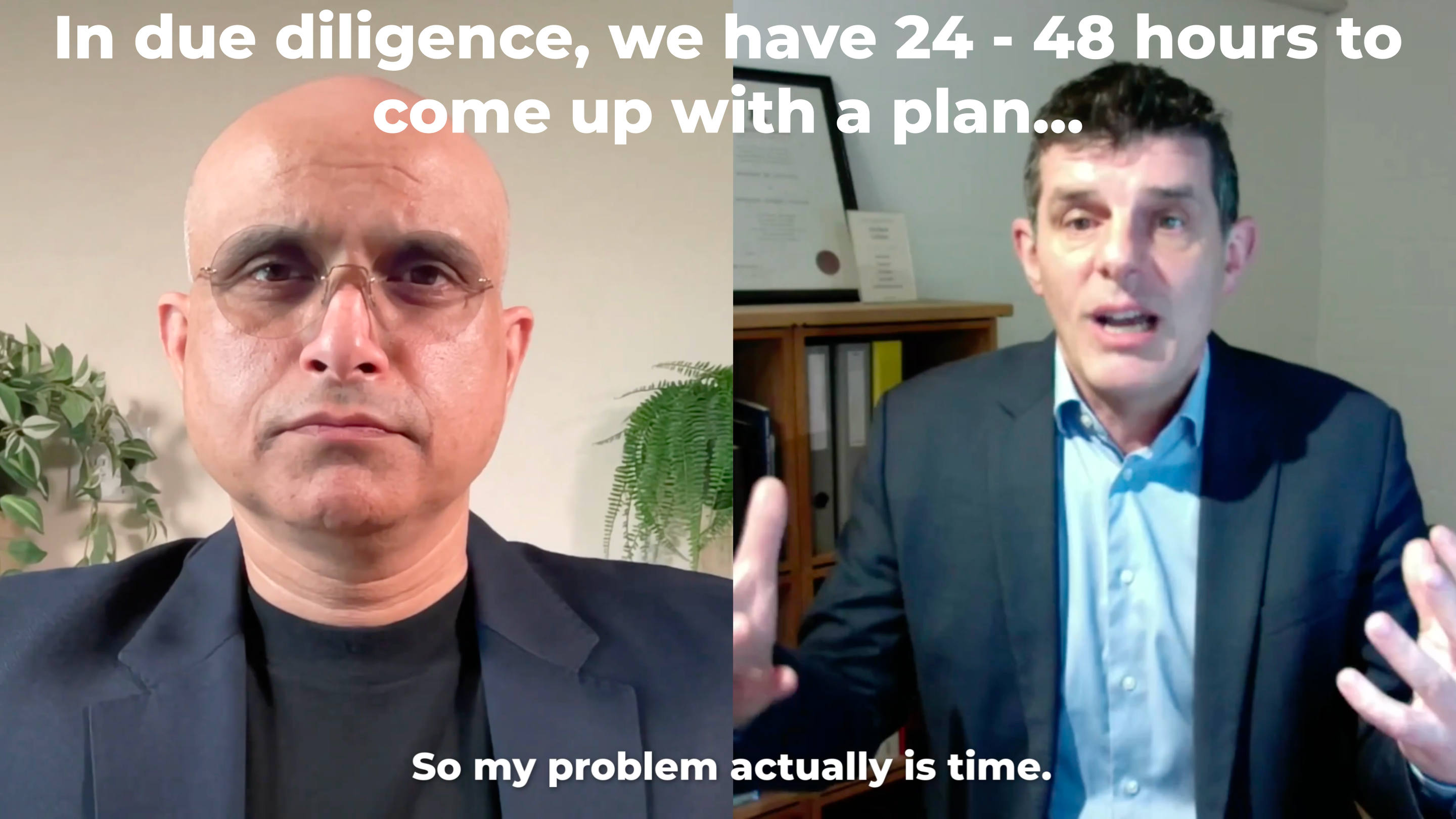
Michael Collins has spent a quarter century in pharmaceutical project management. Global R&D leadership at CSL Behring, where he currently heads research and development project management. Before that, portfolio management leadership at Roche and operational excellence at Novartis. His job, as he describes it, is to transform science into medicines.
So when he sat down to describe what happens when AI agents meet the realities of drug development planning, his perspective carries weight that vendor claims cannot.
This conversation was not scripted. We asked Michael to test our agents on molecules he had worked with before, in therapeutic areas he knew deeply, and to tell us what he found.
The Problem Every PM Recognizes
Michael frames his challenge around three pressures that compound simultaneously. First, coaching and mentoring team members while managing his own workload. Second, producing scenario options under 24-to-48 hour due diligence deadlines. Third, entering new therapeutic areas where no one has a playbook and the research alone can consume weeks.
The common denominator is time. Not capability, not willingness, not talent. Time.
"My problem actually is time. There isn't enough time to be doing everything. So I need help."
He names something that rarely gets articulated in operational improvement discussions: "dead time." The months between building a plan and getting governance to approve it. Months where the plan is already outdated by the time it reaches a decision-maker. Months where information goes stale, scenarios drift, and patients wait.
Anyone who has built an integrated project plan across functions, iterated it through weeks of cross-functional sessions, then watched it become obsolete before the first governance review, will recognize exactly what Michael is describing. As we explored in The Coordination Fallacy, the plan becomes a compliance artifact, not a working tool, long before it reaches the governance table.
What Actually Changed
Michael tested Scoper, our competitive intelligence agent, on a prostate cancer molecule. The scope came back in eight minutes. Competitive landscape, regulatory pathways, Porter's Five Forces analysis, BCG differentiation framework, and source references he could verify independently.
Work that traditionally takes weeks of literature research, expert consultations, and iterative document building.
He then moved to Builder, which generated a work breakdown structure in five minutes, complete with activities, predecessors, durations, and a CSV export he could import directly into his existing project management software. Not a replacement for his tools. An input to them.
"It can take weeks or it can take months. With Scoper, this came back to me within eight minutes. Even with all that updating, all that reviewing, it's in a position that I can go back and present something for a team to build on within a day."
What struck us was not the speed, though the speed is significant. It was Michael's instinct to challenge the output. He tested whether the agent had included the most recent data (information published less than 12 hours earlier). He probed inclusion and exclusion rationale. He verified against his own expertise.
This maps directly to what Harvard Business School researchers found in their landmark study with Boston Consulting Group: AI tools produced the largest performance gains when users had enough domain expertise to evaluate and refine the output. Junior consultants saw a 43% performance improvement, but the gains depended on having foundational knowledge to judge what the AI produced. The researchers called this the "jagged technological frontier," where AI excels at some tasks but produces confidently wrong output on others that appear similar in difficulty.
Augmented, Not Artificial
Michael's framing of this dynamic is precise: not artificial intelligence, augmented intelligence.
"I need to own the output."
A new study in the March-April 2026 issue of Harvard Business Review reinforces this instinct. Researchers found what they call the "AI wall," the point where lack of foundational knowledge limits how effectively workers can use AI tools. Employees with medium expertise nearly matched experts when using AI, but those with the least domain knowledge showed minimal improvement. The technology amplifies existing judgment. It does not replace it.
This is precisely the dynamic we designed for. The agent accelerates the scaffolding. The expert applies the judgment. The result is that the real skills PMs bring, coaching, scenario thinking, conflict resolution, bringing teams together, get more of the time they deserve.
"It gave me more time to go back and provide coaching, or the real skills that us PMs bring: people together as teams, creative brainstorming, conflict resolution, that communication, transformation that needs to take place."
The Skeptic Question
Michael did not arrive as an enthusiast. He had seen tools promise outcomes they could not deliver. His bar was simple: will this be intuitive enough that I am not spending more time correcting the output than creating it myself?
His analogy was precise. Early meeting-minutes technology required enormous effort to correct. Today, it works. His question was whether working with Unipr would feel like the early days or the current state.
"Will working with Unipr be the equivalent to the early days of meeting minutes technology or will it be where it is today? For me, it's where it is today. I was able to use that information straight away."
And then the line that made us pause:
"It gave me back my life. Something that would have taken weeks came back in minutes. Then it took me hours to refine."
Where This Is Headed
Michael makes a prediction that every project manager in life sciences should consider. Within five years, he believes, the traditional approach of building MS Project plans manually with teams will be fundamentally different. Agents will generate the initial output. Teams will refine it. The PM's value will shift from plan construction to plan judgment.
This is not a threat to the profession. It is an evolution. The coordination challenges that slow drug development are not going away. If anything, as portfolios grow and headcounts tighten, the demand for PMs who can think strategically across functions will only increase. The question is whether those PMs will spend their weeks building scaffolding or applying expertise where it matters most.
"Our profession is changing. These tools are going to be in place. You need to learn about these tools. You need to learn how to utilize them."
Michael's answer is clear. And after 25 years, he has earned the right to make that call.
Watch the full conversation above.
References
- Harvard Business Review, "Gen AI Won't Make Your Employees Experts." March-April 2026. Medium-expertise workers nearly matched experts when using AI, but low-expertise workers showed minimal improvement, revealing the "AI wall."
- Dell'Acqua, McFowland, Mollick et al., "Navigating the Jagged Technological Frontier." Harvard Business School Working Paper No. 24-013, September 2023. 758 BCG consultants: AI users completed 12.2% more tasks, 25.1% faster, with 40%+ higher quality on tasks within AI's capabilities.
- Harvard Business Review, "How Do Workers Develop Good Judgment in the AI Era?" February 2026. AI creates a challenge: experienced workers get huge productivity gains, while junior employees often cannot evaluate whether AI-generated work is correct.
- Harvard Business Review, "AI Doesn't Reduce Work, It Intensifies It." February 2026. Eight-month study: AI users worked faster and took on broader scope, but workload creep can become the new baseline.
Further Reading
- How Empowering a Single Role Unlocks $87M+ in Portfolio Value
- The Coordination Fallacy: Two Realities in Drug Development
- Headcount Is Not Capability: Why Pharma Keeps Hiring and Firing Its Way to the Same Problem
- Four Companies Wearing One Logo: The Architecture of Disconnection

Compliance
Unipr is built on trust, privacy, and enterprise-grade compliance. We never train our models on your data without your explicit request.





Start Building Today
Log in or create a free account to scope, build, map, compare, and enrich your projects with Planner.