


Despite Scenario Planning, Why Can't Your Teams Pivot Fast Enough
You can model a dozen futures and still not pivot when one arrives. The gap is not foresight. It's whether the scenario ever reaches the work, the people, on the day.

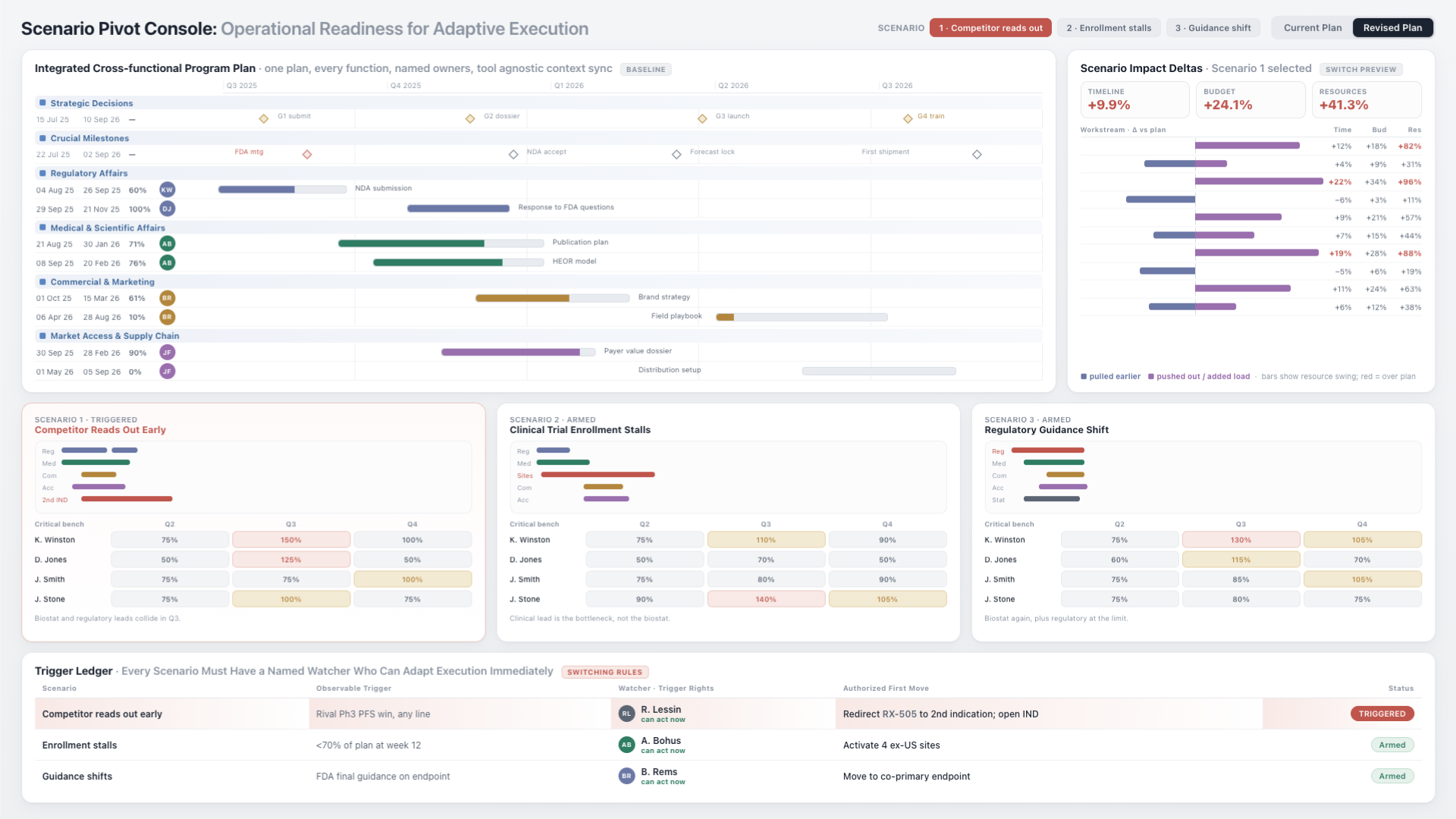
The readout drops at 7:14 am on a Monday, and by the time the team has its coffee, the competitor has all but won. Their pivotal trial hit. Approval is still a filing and a review away, but a clean pivotal settles it: they will reach the market first, and that lead takes the guidelines and the formulary that follow. Your own trial is six months behind theirs, and in a two-drug race, six months is the distance between first and forgotten.
The room knows what to do. If they can't be first here, they can still be first in the second indication, the one the science always supported, and the strategy kept deferring. Pivot the program there. Heads nod. It is the right call, and everyone can see it.
Then someone asks the obvious question. We modeled this, didn't we? We have a plan.
There is a plan. It is a slide. Built eighteen months ago, for a market that has since moved, by someone who has since moved on. It gestures at the second indication. It doesn't say which studies stop and which start, what comes off the critical path and what lands on it, who is freed and who is suddenly overcommitted, or what the new timeline costs in months and dollars. It points. It can't be run.
Then the quieter problem, the one that surfaces an hour later in a hallway rather than in the room. The pivot needs the one regulatory lead who has actually run an accelerated approval, the only way to reach the market fast enough to still be first. She is on the program down the hall, already committed to a filing of its own this quarter. Your pivot didn't create that collision; it walked into one nobody had mapped. No one has yet said out loud that she can be on only one of them. They will, in about two weeks, when it is a crisis instead of a choice.
Nobody here did anything wrong. The plan was sound the day it was written. The team is good; the science is fine. The only thing that happened is that the world moved, which is the one thing every plan quietly assumes it won't. But it always does, and today, faster than it used to. The window in which three or more competitors crowd into the same disease area has compressed from roughly fifteen years to about two. The Monday that rearranges a program is no longer a rare event. It is the tempo.
Like most in the industry, this company, too, is good at scenario planning. A handful of futures modeled across the portfolio, every program with a few strategic options, each carrying its own risk-adjusted value, the best mix read off an efficient frontier, all of it refreshed every quarter by capable people. By expected standards, this organization checks the box on operational readiness.
And yet, none of it tells anyone what to do differently on Monday.
The gap has nothing to do with effort or talent. It is a gap of altitude, the forest view and the tree view. Scenario planning in life sciences takes the forest view, where the money is: the portfolio, the valuation, the funding line. The pivot has to happen at the level of the trees, where the work is: the studies, the schedule, the named people who would execute what, why, and when. Even the options priced on every program belong to the forest view: they say what a program is worth under a given future, not how specifically it would change course if you chose one. The industry studies the forest and assumes the trees will tend themselves. They won't. A forest is built from its trees, not the reverse; leave them untended and it withers.
And even the forest is thinner than it looks, because at the portfolio altitude scenario planning is mostly an annual exercise, a budget wearing the word strategy, refreshed on the planning cycle rather than on the day the world changes. The boardroom holds a dozen futures it modeled last quarter, and yet the bench still can't move today, because none of those futures were wired to the actual work, none carried a trigger anyone had agreed to, and none revealed that the one person the switch depends on was already spoken for. A static top, a manual bottom, nothing alive in between, and hope, the only real strategy.
So, the question is not whether you do scenario planning. You almost certainly do. It is whether any of it reaches the work. Despite all of it, why can't your teams pivot fast enough?
The Pivot Waits for a Meeting
Go back to the room. Everyone agreed the pivot was right. What no one could say was when it should have happened, because no one had ever written down the condition that would make it a no-brainer. There was no line in any document that read: if the competitor's pivotal reads out positive here, we move the program to the second indication. The readout itself was no surprise; its date had sat on every analyst's calendar for a year, and only the result was ever in doubt. The trigger was knowable that far out, and never agreed, so the switch waited for a meeting, and in the meeting, it waited for whoever argued most confidently.
Most teams, asked directly, can describe a Plan B. Far fewer can name the observable signal that fires it, who watches for that signal, and who is allowed to act when it trips without reopening the entire debate. A scenario without a trigger is a conversation, and the conversation happens only when someone finally calls the meeting, which is usually after the cost is sunk.
There is a deeper version of this. The trigger a team misses is usually the one for a fork it never thought to plan for. Programs rehearse the forks already on the Gantt chart: the readout, the dose decision, the efficacy signal. Those are the respectable ones, the forks a development plan is built to expect. The forks that actually rearrange a program arrive from outside it: a competitor reads out early, a contract manufacturer slips, a guidance moves the regulatory path, a funding line vanishes. Those are the disruptions nobody war-games. According to one 2026 industry survey, only about a fifth of pharmaceutical companies have built any formal scenario-planning or geopolitical-risk capability. The rest meet the shock the way the team in the room met theirs, for the first time, on the day it arrives.
Pre-committing is rare, and not because anyone is lazy. Naming the trigger in advance feels like betting against your own plan; the lead who says exactly what would make him stop the program sounds, in the room, less committed than the one who says nothing. The incentives reward silence. The usual objection is that the science is too uncertain to pre-commit, but that confuses the outcome with the trigger. You can't know whether a competitor's molecule will work. You can know the date they read out and today agree on what you will do if it does. The uncertainty is in the result, not the signal, and it is the signal you commit to. Spotting that an assumption has broken, which I have written about before, isn't the same as having decided in advance what to do the moment it does.
And once the decision is finally made, the machinery is slow. A substantial protocol amendment now takes a median of 260 days to implement, and sites run on divergent versions of the protocol for 215 of those days. The pivot the room approved on Monday doesn't reach a patient for the better part of a year. The one approach that builds the switch in from the start, the adaptive design, still appears in fewer than 1 in 10 Phase III trials. The default is a single fixed path, decided once, changed by hand under pressure. In practice, it shifts more than leaders expect: nearly 4 in 5 Phase III trials revise their completion date at least once before they end.
When Two Pivots Reach for the Same Person
Say the trigger had existed. Say the team moved the moment the competitor read out, cleanly, on a pre-agreed signal. They would have walked straight into the second problem, the one already waiting in the hallway. The pivot needs the regulatory lead who has run an accelerated approval, and she is already committed to a filing on the program down the hall. The shortage was there before the readout; the pivot is only what made you reach for her and learn she was already spoken for. Two claims, each reasonable on its own, on someone of whom the company has exactly one.
The people who gate a pivot are not interchangeable. One head is not equal to one, as a research-operations leader at a large pharma told me, because the skill that matters is specific and the bench that holds it is short.
Scenario planning has always been something a program does for itself. Each program models its own futures and prepares its own alternatives, in its own plan, as if it were the only claim on the company's people. It isn't. Programs are joined beneath the surface by every specialist, every manufacturing slot, every regulatory writer they share, the invisible dependencies that run through a portfolio like dark matter. A program's Plan B can be sound in isolation and impossible in aggregate, because the alternative it leans on is the same alternative three other programs are counting on.
It would be easy to file this under resource allocation. But allocation is the steady state, and a portfolio can be perfectly staffed on a Monday morning and impossible by the afternoon, the moment two programs decide to move. The collision is what that steady state does under a shock, and no staffing plan drawn for calm survives it.
The portfolio review cannot see this when it values each asset on its own. At the time of the decision, the contention is hidden, because the model carries people as a pool, for instance, twenty people of this role in that quarter, but a pool can't tell you that the program about to pivot needs the same handful of names another program is already using. And the contention doesn't hold still. It redraws itself every time anyone switches paths: the pivot that frees a statistician on one program lands a fresh demand on another. No one models that interaction, because there is no shared place where the alternatives of one program meet the alternatives of the rest.
So, the collision surfaces the only way it can. Late, in a corridor, as a fight over a calendar that two directors each assumed was theirs. Only about 1 in 5 life sciences leaders say their operating model lets them make cross-functional calls in time. The other four find out what resources their programs share the week it goes wrong.
The Option You Only Think You Have
A comfort keeps single-path planning feeling safe. We can always amend the protocol. We can always re-source the program. We can always find another supplier. The flexibility is assumed to be sitting in reserve, available the day it is needed. Most of the time it isn't. An option you didn't build in advance isn't an option you can exercise inside the window you actually have. The amendment you could "always" make takes 260 days. The supplier you could "always" switch to needs the better part of two years of qualification before it can release a single batch. The flexibility was real on a whiteboard and a pipedream on the calendar.
This is the same distance between an estimate and a calculation that runs through the rest of development, here applied to optionality itself. "We can adapt" is an estimate. A pre-positioned alternative, with the work mapped, the trigger set, and the people named, is the calculation. Only one of them is in the room when you need it.
There is a reason the calculation is rarely done, and it is financial. Keeping a real option alive costs money now. A second qualified supplier, a backup site, a parallel formulation, a specialist held in reserve rather than billed to a program: each is a cost today against a benefit that may never be needed. So, when the budget tightens, and right now it is tightening hard, with more than $300 billion of revenue going over the patent cliff this decade and R&D budgets already being cut, optionality is the first thing struck from the page. The organization sheds the ability to change just as the rate of change is climbing. It feels like discipline. It is closer to selling the umbrella because today happens to be dry, in a season of storms.
Hold Fewer Futures and Wire Them to the Work
None of this argues for more scenarios. A team buried in contingency decks is no better off than one with a single plan. It just has more slides to ignore. The argument is for fewer alternatives, held properly, so that the moment conditions shift, the team is not designing a response, it is choosing one.
A real alternative differs from a rhetorical one in three ways. It carries a trigger. Not a vague intention to revisit, but an observable signal agreed in advance, with one person named to watch for it and one named to act the moment it trips, so the switch needs no meeting. It is built all the way down: a plan ready to run rather than a direction, with the studies that stop and start, the work moving on and off the critical path, the people freed and loaded, the cost, and the regulatory minimums that can't be compressed left intact. And it lives across programs rather than inside one, so the moment two alternatives reach for the same specialist, the collision surfaces before you commit, not after the program has already stalled.
The reason this was never standard practice wasn't that anyone believed one plan was enough. It was that building a few executable alternatives for every program, and keeping them current as the science moved, took weeks by hand and went out of date almost before it was done. So it was done once, for the budget, and shelved. That is the part that has changed. Holding a selected set of live, triggered, validated, cross-program alternatives is now something a system can maintain in the background, at the resolution where the work actually happens, rather than something a team rebuilds by hand each time, always a step behind the event.
What stops a team from being ready is no longer the cost of getting ready. It is the habit of treating a plan as a promise to be kept rather than a position to be revised. Adaptability is a choice, and so is the discipline of planning the alternatives before you need them.
The Cost of a Plan That Cannot Move
Every one of these delays carries two prices, and the industry is fluent in only one of them. The revenue price is the one that gets modeled: the months a program slips while the pivot is debated and staffed by hand, each day of slip worth, by recent estimates, on the order of $800,000 in forgone sales; the competitor who reaches the same indication first because their team moved in weeks while yours moved in quarters; the exclusivity burned off the front of a patent life that was always going to be short. That price is real, and in a season of patent cliffs it is climbing.
The other price doesn't appear in the model. Behind the second indication the team deferred is a group of patients for whom the current options have run out, waiting on a therapy the science has already delivered and the operations haven't. A pivot that takes a year instead of a quarter is nine months those patients do not have. Whether the medicine works is settled by the science. When it reaches them is settled by how fast the company can change course, and that is the half we keep treating as someone else's.
So the question every program should settle in advance, while the plan still holds, isn't whether the bet is good. You have spent enormous effort making sure it is. It is the plainer one that gets left for later. When the plan meets the day it didn't expect, and it will, what is the signal that tells the team to change direction, who is watching for it, and will the one person we'd turn to be free that day, or already spoken for? Answer that before the readout drops, and the pivot is a decision. Answer it after, and it is a scramble against a calendar you no longer control.
References
McKinsey & Company, "Simplification for Success: Rewiring the Biopharma Operating Model" (2025).
Deloitte, "Measuring the Return from Pharmaceutical Innovation 2025."
BioSpace, "Pharma R&D Spend Drops 3.6% as Pipeline Prioritizations Take Shape" (2026).
Outsourced Pharma, "2026 CDMO Forecast: The Shifts Sponsors Need to Prepare For" (2026).
Further Reading
Of Course... How Assumptions Fail Programs at Predictable Inflection Points. On how the assumption beneath plans break quietly. Here we discuss: what you do when it does.
The Question Your Portfolio Review Never Truly Answers. On contention at the moment of decision. This piece makes that contention dynamic: what a pivot does to it.
Estimating Is Not Calculating: The Resource Precision Gap Between Planning and Execution. On the difference between an estimate and a calculation, here applied to optionality.
Dark Matter in Drug Development: The Invisible Dependencies Driving Your Portfolio. On the cross-program dependencies a pivot collides with.


Compliance
Unipr is built on trust, privacy, and enterprise-grade compliance. We never train our models on your data without your explicit request.







Start Building Today
Log in or create a free account to scope, build, map, compare, and enrich your projects with Planner.