


Organizational Intelligence: The Enduring Advantage When AI Is Everywhere
When the best AI is something any company can buy, the advantage shifts to the organization itself: how well it sees its people, moves as one, and remembers.

Every executive is circling the same question in 2026, and few will say it plainly. Within a few years, the best AI will be something most organizations can buy. Same models. Same access. Same price list. When the instrument is that evenly shared, what is left to separate one company from another?
For a while the answer was supposed to be the instrument itself. Compute was the edge, until it became something you rent by the hour. Then it was the models, until the good ones began arriving every few months, from everyone. So the smart money moved to data, the one moat that looked like it would hold. But data is a record of decisions already made, a fossil of what people once saw and chose. It tells you where an organization has been, and little about what it can do next.
The most expensive test of that faith is running right now, in life sciences. The industry took the most powerful tool it had ever been handed and pointed it straight at the glamorous problem, the molecule. At BIO 2026, top biopharma leaders described the gap between promise and result: AI is making parts of the work faster, but it has not yet transformed end-to-end timelines or cracked biology's harder problems. The molecule finder alone was never the moat. The edge is in something quieter: how well a company uses the people, knowledge, and judgment it already has to convert promising science into effective medicines that patients can access quicker than ever before.
When the tools equalize, the difference walks in on two feet. It is not the tool, or the model, or the harness built around it. It is the wielder. Hand the same instrument to two organizations and you will get two different results. The difference comes from how well each organization can see the capability inside its own walls, aim it at the right problem, and remember what it learned the last time. That capacity has a name. Call it Organizational Intelligence.
Which is not the same as saying people are your greatest asset. Every annual report prints that line, and few operating models are built around it. The edge is narrower: the exact capability, judgment, and desire inside a person, and the intelligence to find it and use it.
This is an old problem, newly visible. In my last essay, I talked about the plan that kept describing a program the world had already moved past. That was one small instance of a larger pattern: an organization managing the one thing it could see clearly, the document on the table, while the forces that actually decided a program's outcome ran on unwatched.
What Decides the Outcome Is Invisible
Trace any program back from its result, and the causes are rarely in the documents. A trial runs cleanly because the one scientist who was critical to the assay was on the team, and not lent to two other programs the same quarter. A submission holds together because specific regulatory and manufacturing specialists were aligned on different aspects of the same molecule, and not two subtly different ones. A good decision gets made because someone in the room remembered why the last team had walked away from that exact idea. These are the facts that drive outcomes, and none of them fit into a spreadsheet cell.
So we manage what does fit. Headcount, utilization, title, budget, milestone dates. Everyone knows these are stand-ins for the real thing. We use them anyway, because they are legible and the systems accept nothing else. The most valuable knowledge in a laboratory is the kind a scientist cannot fully put into words, the judgment that took twenty years to build and lives below the level of speech. We know more than we can tell. So instead, we count people, because a headcount has a number and capability does not.
That is the deeper reading of the status report from last week. The report was legible, but the actual state of work it represented was not. The report was manageable precisely because it had flattened a moving, uncertain, human reality into fields you could sort, and every field was a proxy. The date stood in for a distribution. The role stood in for the person. The green status stood in for a truth no one wanted to type. Manage the proxies long enough, and you forget they were ever proxies at all.
It is also why the two standard fixes keep disappointing. A better plan sharpens the legible surface. A reorg redraws its boxes. Neither one reaches the capability, the coordination, or the memory underneath, which is why a cleaner plan and a new org chart so rarely make the pipeline move faster.
An Organization Is an Intelligent System
Strip away the org chart, the buildings, the processes, and the systems, and an organization is a living intelligence: a group of people trying to understand what is changing around them, decide what matters, and act together before the moment passes.
That is what intelligence is: a capacity to perceive what is true now, coordinate a response, and learn from what follows. Organizations succeed or fail by the same test. They sense well or poorly. They decide quickly or slowly. They act as one system or as fragments.
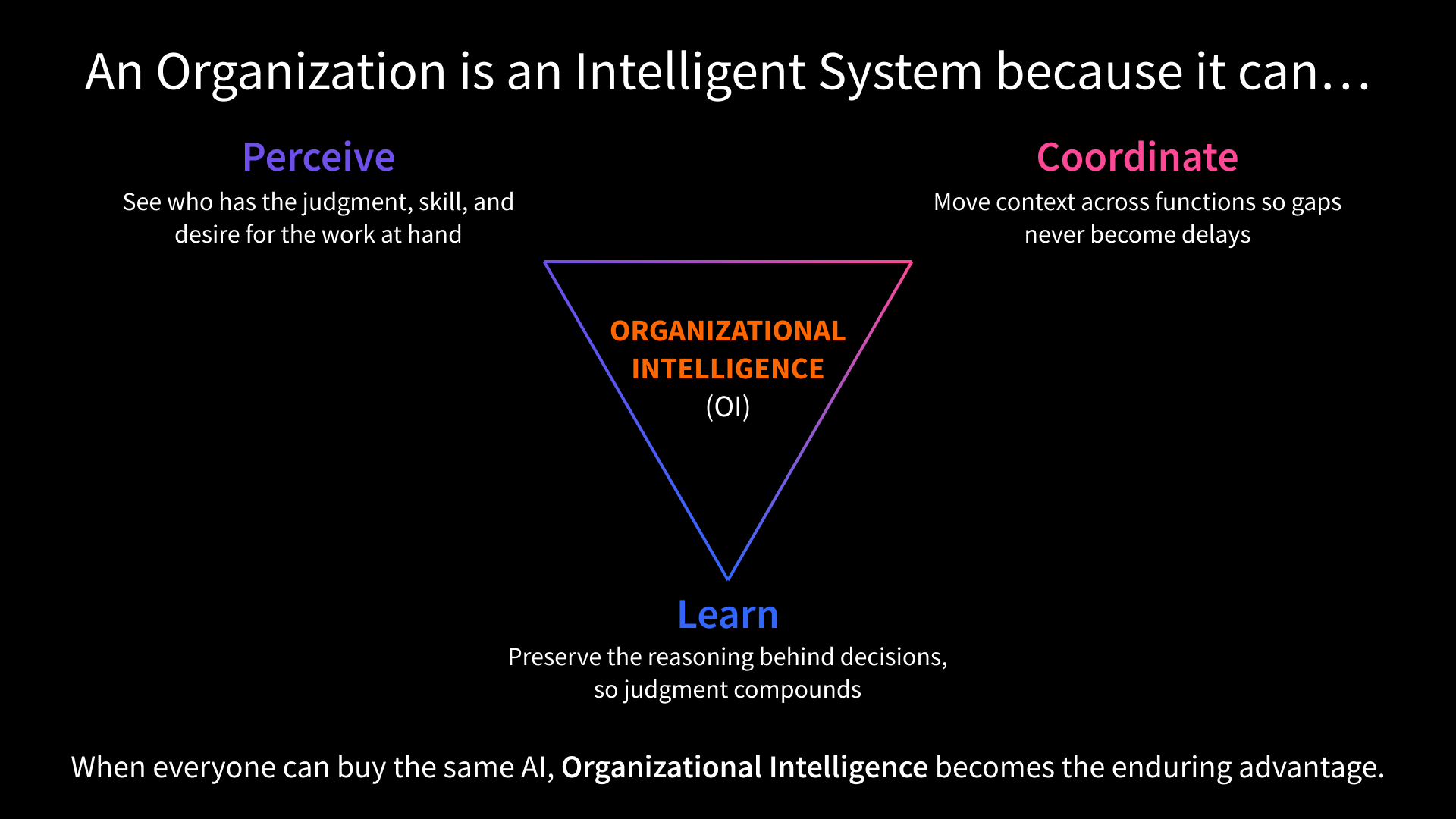
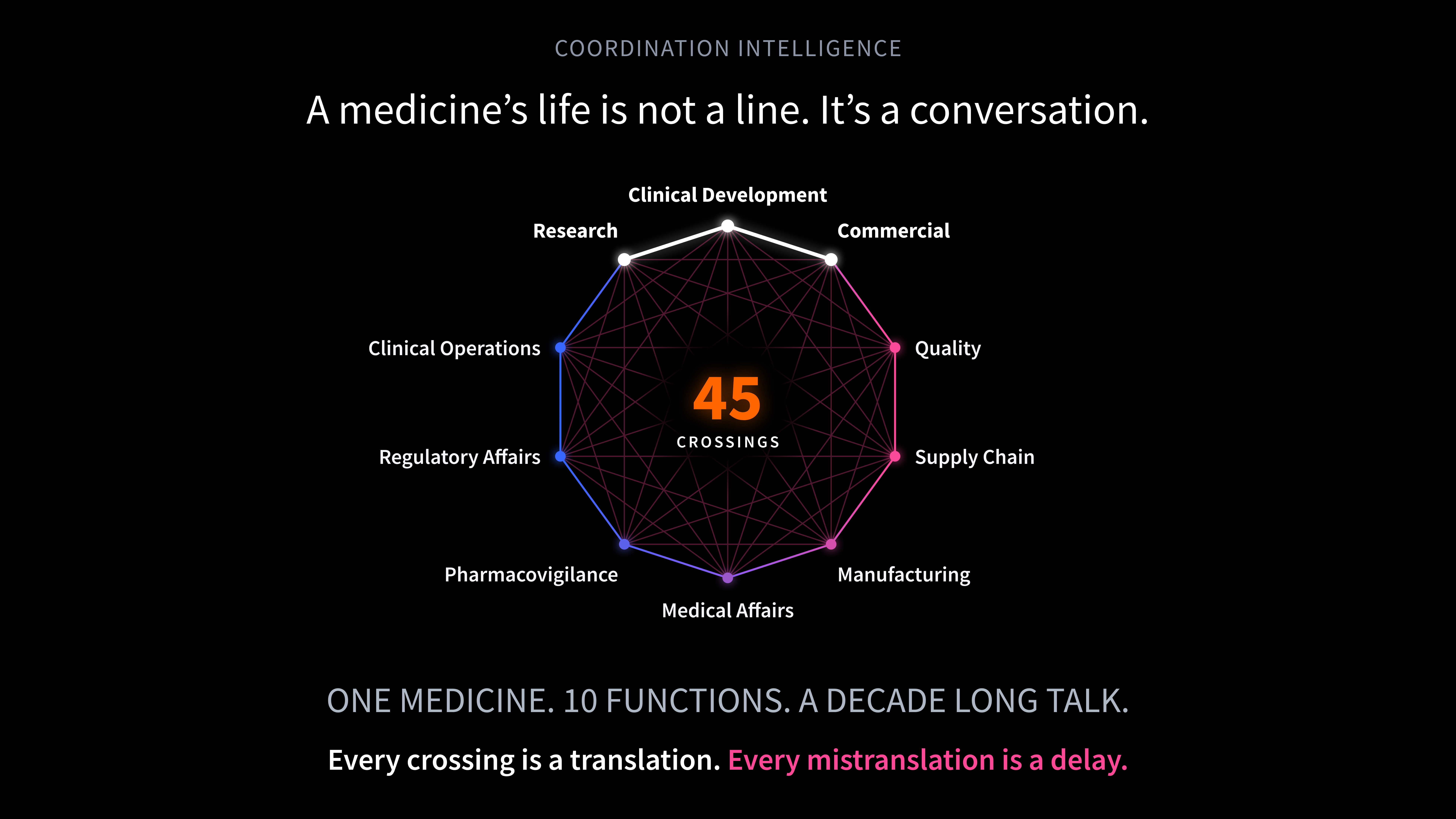
Seen that way, Organizational Intelligence has three faculties. An organization has to perceive the capability and desire inside its own walls, and match them to the work where they matter most. It has to coordinate, so context moves across functions and the enterprise acts as one company rather than as four companies wearing one logo. And it has to learn, preserving not only what was decided, but why, so judgment compounds instead of leaving with the person who held it.
Perceive. Coordinate. Learn.
Give those faculties their operating names: human potential, collective intelligence, and organizational learning. They are the three pillars this series will take up one at a time in the weeks ahead. Together, they are what I mean by Organizational Intelligence.
None of this is new as an aspiration. Every leader wants to see their people clearly, break the silos, and stop relearning the same lessons. What has been missing is the machinery to make it real.
That machinery is now beginning to exist.
The honest objection, of course, is that most large organizations believe they already do these things. Their data is connected. Their function leaders know their people. Their knowledge lives in the systems.
But each claim confuses a record with a capability.
Connected data is not the same as coordinated action. A cloud data lake may hold the records, but it does not supply the context that makes them useful: the relationships, rules, dependencies, exceptions, and meanings that turn data into judgment. That is why Gartner warns that AI agents without organizational context become inaccurate and unreliable, and why it expects so many agentic-AI projects to stall before they scale: the context that would make them useful is not sitting in the data lake.
The same gap runs through people. Most organizations know titles, reporting lines, locations, and utilization. Far fewer know what their people can actually do, where their judgment is strongest, what kind of work gives them energy, or where they have solved a similar problem before. A headcount system shows the assignment. It rarely reveals whether the match is right.
The third gap may be the most expensive: memory. The knowledge that matters most is often not the decision itself, but the reasoning behind it: the assumptions made, the options rejected, the risks accepted, the signals watched, and the lesson learned afterward. That is the knowledge least likely to be captured. It sits in conversations, meetings, inboxes, and the heads of people who eventually move on.
These gaps show up in the operating record: slow handoffs, repeated mistakes, misallocated expertise, and decisions made without the context that should have been available.
Each gap opens one pillar of the series ahead. For now, the point is simpler: the forces that decide performance are no longer impossible to see. The question is whether leaders will build the capacity to see them.
The Machine Learns What We Can't Say
For most of the history of information technology, the illegible stayed illegible because a machine could only work with what someone had already written down. If a task could not be reduced to explicit rules, it remained stubbornly human. The economist David Autor gave that barrier a name a little over a decade ago: Polanyi's Paradox, after the observation that we know more than we can tell.
The work that resisted the machine was exactly the work that ran on tacit judgment. Reading a room. Sensing that a program was about to slip a month before the dashboard showed it. Knowing which scientist to put on which problem. For a long time, that was a hard wall.
The wall is moving.
This generation of AI does not need every rule spelled out in advance. It learns patterns from data, the way a child learns to ride a bicycle without being able to explain the physics of balance. For the first time, machines can read some of the traces that tacit judgment leaves behind: the decisions, outcomes, handoffs, exceptions, and choices a team makes again and again. They cannot capture judgment whole. But they can surface the pattern it leaves and let an organization test whether acting on that pattern improves the outcome.
That test is the part that was missing.
The evidence is already concrete. In a Stanford and MIT study of more than five thousand customer-support agents, an AI assistant trained in part on the behavior of stronger performers raised the productivity of the newest workers by 34% and barely moved the veterans. The likeliest reading is that it surfaced some of the practices of the best agents and spread them to the rest: not the whole of what they knew, but enough of the pattern to move a novice up the curve.
The same logic can reach into a laboratory. The instinct that tells a veteran which of two assays will hold, or that a program is drifting weeks before the numbers admit it, leaves a trail in the record. These systems are beginning to read that trail.
In a portfolio organization, it would look ordinary. The same tangle of regulatory, clinical, and manufacturing dependencies that stalled three programs before is recognized as it forms again. The few people who untangled it last time are found. The reasoning they used is kept rather than lost when they move on. The next program is routed to them before the delay hardens, and someone checks, a quarter later, whether cycle time actually moved.
The machine does not have to read minds. It only has to make better use of the record the work already leaves behind.
This is why the question matters now in a way it did not five years ago. The same AI that gives every company broadly similar power is also the first tool that can strengthen what AI itself cannot equalize: how well an organization sees its people, connects them, and remembers what it learns. The tool everyone can buy is also the one that sharpens what only you have.
Digital Intelligence Is Different, Not Superior
One of the field's founding figures would stop me here. Geoffrey Hinton, who did as much as anyone alive to build these systems, argues that digital intelligence may simply be the superior kind, and his case is not weak. A model is immortal: the same weights run on any machine, so its knowledge does not die with the body that held it. And it is endlessly copyable: a thousand instances can each read a different corner of the world and pool what they learned by the afternoon. In his Nobel interview, Hinton put the odds that machines surpass human intelligence within five to twenty years at about 50%.
He may be right about the horsepower, but "superior" may be the wrong frame.
Digital intelligence is not biological intelligence made larger. It is a different kind of intelligence, produced by a different kind of computation. It will be better than us at some things: reach, recall, replication, pattern detection, and speed. It will be worse at others: lived context, embodied judgment, moral responsibility, desire, and a human stake in the outcome. The point is not to decide which intelligence wins. The point is to understand what each is for.
That is why Yann LeCun's objection matters. LeCun, who shared the Turing Award with Hinton, argues that today's language-based models do not understand the world the way humans do, and that language alone will not get them there. Whether he is right in full is beside the point. The useful lesson is simpler: machine intelligence and human intelligence are not interchangeable. They are different instruments.
For organizations, that distinction matters. A model's great advantage is that every copy can be identical and instantly synced. That is also why the model alone cannot be what separates one company from another. If everyone can run the same model, the model is not the difference. Hand a thousand companies the same one, and the gap between them still comes from the people asking the questions, framing the problems, supplying the context, and deciding what to trust.
That puts real weight on one word: perceive.
The promise of Organizational Intelligence is to see, at last, the capability and desire inside people. The hazard is that seeing hardens into flattening. The last time we made human work legible at scale, we got the assembly line and the interchangeable worker: a person reduced to the motions a stopwatch could clock. Do that again to a scientist, shrink her to a vector of skills, and you have rebuilt the cage you meant to open.
People are not interchangeable, and neither are their skills. No two scientists are alike. The point of perceiving them is to honor that, not average it away.
Perceive the irreducible without reducing it.
The Real Moat Is Human Capability
So the question every leader keeps circling back to comes with an answer. When the instruments are equal, the edge is the organization itself: how clearly it sees its own people, how well it moves as one, and how much it remembers. That can sound soft until you notice that each of the three is something leaders can build.
None of this asks a leader to rebuild the enterprise on Monday. Start with one recurring decision, handoff, or dependency that keeps slowing a program down. Name the signals that appear before the trouble does. Find the few people who handle it well. Preserve the reasoning behind their calls where the next team can reach it. Then check, later, whether the outcome moved.
One loop closed, then the next. Organizational Intelligence starts small. Then it compounds.
The means to perceive the illegible now exist. The open question is what organizations do with them: whether they use this new sight to understand their people more truly, or merely to watch them more closely. That choice sits with the wielder, not the tool.
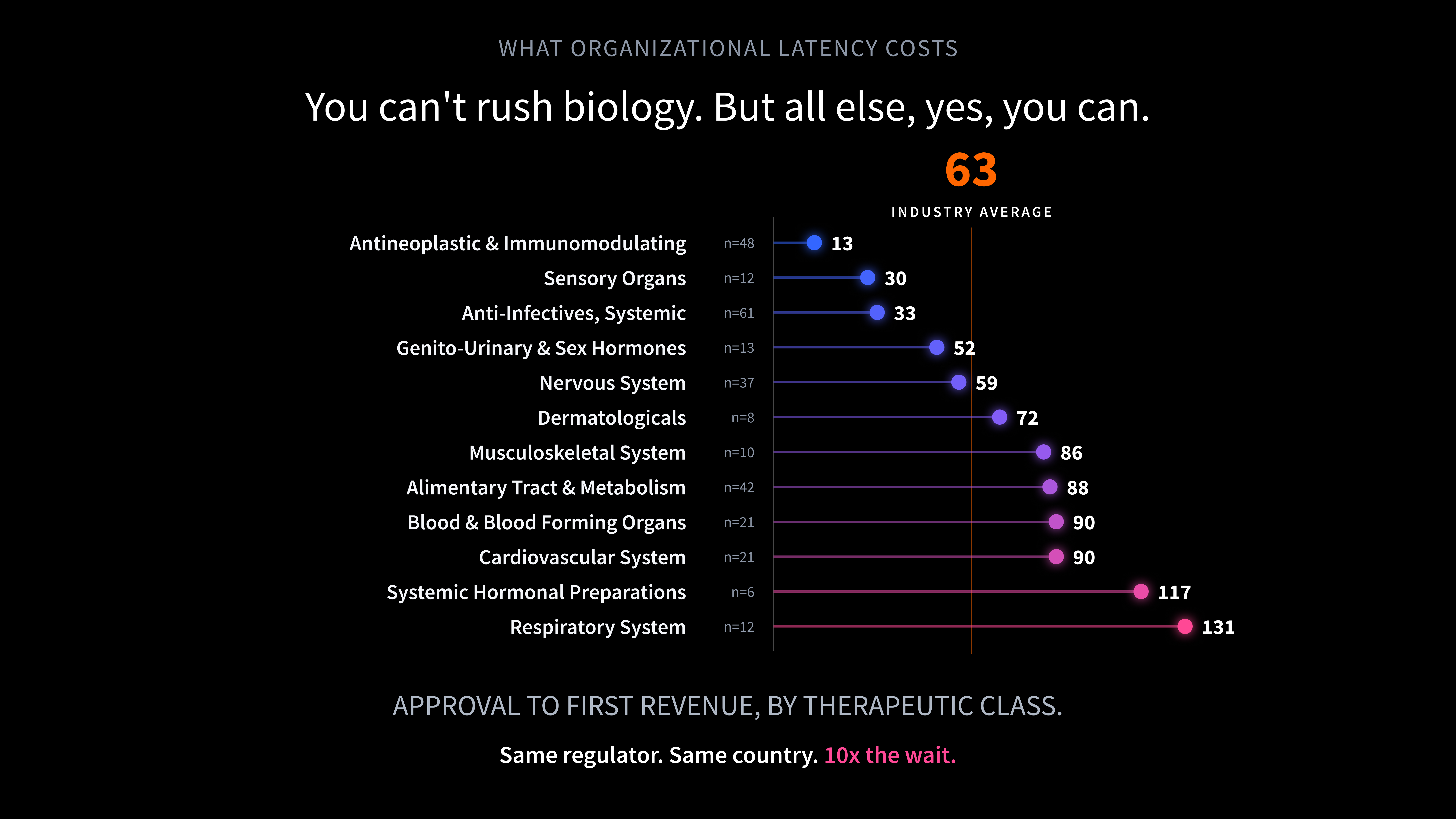
The stakes are not only commercial, though the commercial case is real enough. In research I conducted at MIT across 305 US drug launches, the average delay from approval to market availability was 63 days. Later Unipr analysis showed how even short delays can translate into meaningful lost revenue. But the deeper cost is human. Some portion of those 63 days is avoidable coordination cost, and in this industry coordination delays become patient delays. At the end of the line is a person waiting on a medicine the science may already have made possible. How fast it reaches her increasingly depends on the organization behind the science.
This series takes the three faculties one at a time, with a plain question for each. Can your organization see the capability inside it? Can it coordinate that capability across the walls between your functions? Can it remember what it learns? The weeks ahead are about what it takes to answer yes to all three.
For a long time, the forces that decided our outcomes were the ones we could not see. That is the part that just changed. When the tools are the same in every hand, the company that pulls ahead is the one that sees its people most clearly, moves as one, and forgets the least.
We start, next week, with perception.
References
Pharma leaders on AI's uneven returns in drug discovery, PharmaVoice, BIO 2026 coverage.
Yann LeCun & Jacob Browning, "AI and the Limits of Language," Noema (2022).
Gartner, "Lack of Semantics Causes Inaccurate AI Agents and Wasted Spending" (2025).
Andy Mehrotra, launch-delay analysis across 305 US drug approvals (approval to market availability), MIT Forum for Health Economics & Policy, Frontiers in Health Policy Research (2010); revenue impact from Unipr analysis (Evaluate Pharma top-selling drugs, FDA approval history).
Further Reading
You Can't Run a Movie from a Single Frame: Why Static Plans Fail in Dynamic Industries. The plan as one small instance of managing the legible while the real work runs unwatched.
Four Companies Wearing One Logo: The Architecture of Disconnection. Why coordination is a faculty most organizations have to build, not a given.
People Are Not Your Greatest Asset. Their Skills Are, But Only When Applied to the Right Task at the Right Time. On perceiving capability without flattening the person.
The Coordination Fallacy: Two Realities in Drug Development. What it takes for context to actually flow across functions.

Compliance
Unipr is built on trust, privacy, and enterprise-grade compliance. We never train our models on your data without your explicit request.





Start Building Today
Log in or create a free account to scope, build, map, compare, and enrich your projects with Planner.