


What Your Forecast Counts On, Your Plan Doesn't Know
A forecast depends on a few conditions beyond the science. Most companies know them. The harder question is whether the plan connects the work behind them.

The letter arrives a few months after approval.
The medicine works. The regulator agreed, and the team celebrated, as it should have. Now Germany's Federal Joint Committee (G-BA), the body that judges whether a new medicine offers more than the treatments patients already receive, has finished its assessment. Its conclusion: no added benefit has been shown.
German patients can still get the medicine. What changes is quieter, and for the business it is serious. Instead of the premium the launch forecast assumed, the reimbursement price will now be constrained by the cost of the existing treatment. The forecast was built on the medicine being shown to be better. The assessment says the evidence doesn't show it.
The reason is the comparator, the existing treatment a trial measures the new medicine against. The Phase 3 trial, the large late-stage study that produced the evidence for approval, compared the medicine against a treatment the German assessors don't consider the right yardstick for these patients. Measured against the wrong yardstick, the benefit they were asked to judge couldn't be demonstrated.
Walk it back. The comparator was chosen three years earlier, when the Phase 3 protocol was finalized. The clinical team had good reasons. The regulator was comfortable with it. Patients were easier to recruit. The timeline held. Someone in market access may well have raised a concern along the way; in a large program, someone usually does. But the choice was made, the protocol was locked, and every milestone after that was met on time.
The program in this story is pieced together from several real ones, and I have watched every piece of it happen.
What the forecast depends on
When a company decides a program is worth hundreds of millions of dollars, that decision rests on a forecast: how many patients will be treated, at what price, starting when, and for how long. Ask the person who built the forecast which handful of things it depends on most, and you'll usually get an answer within the hour. For a typical program the list looks something like this:
- the comparator payers will expect the trial to have beaten
- the claim on the label, the official description of what the medicine is approved to do, that supports the price
- the timing of the company's launch relative to its nearest competitor
- the first indication, meaning the disease or patient group the medicine is approved for, and whether it opens the way to the next one
- enough manufacturing supply on the day demand arrives
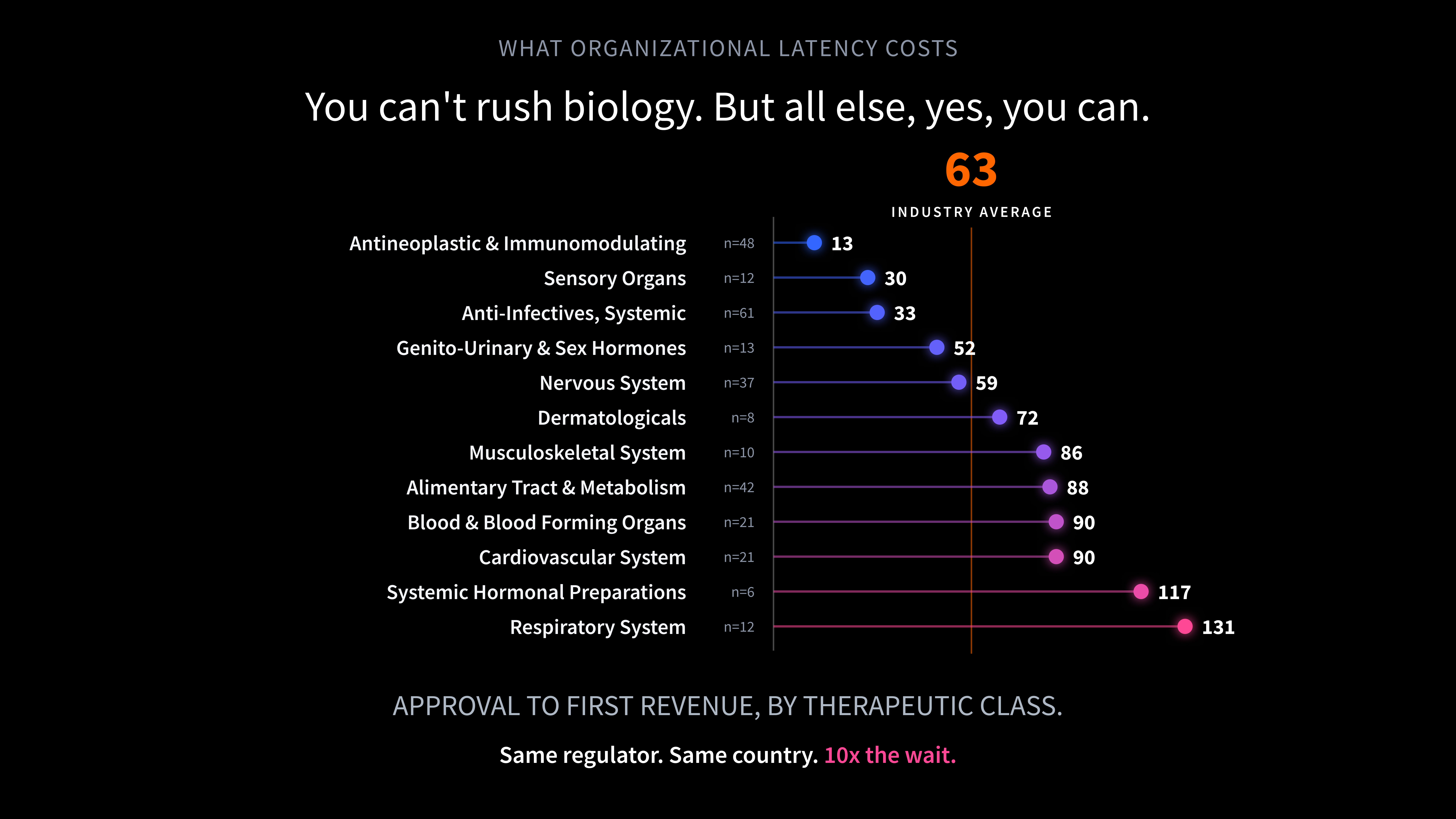
Whether the medicine works is a scientific question, and science takes the time it takes. But whether the right trials have been designed to show its value, whether the right advice was sought before committing to those trials, and whether the company is ready for the market it expects to enter are questions of planning and execution. That is the part of every timeline I think of as organizational time, and it is the part people can change.
Most large companies know all of this. The main tool for it is the target product profile, a document written early in development that describes the medicine the team is trying to bring to market: who it is for, what it should demonstrate, and the label it hopes to earn. When researchers surveyed 11 large pharmaceutical companies, every one said it builds payer requirements into that profile, and payer perspectives were built into development plans as well (Wang and colleagues, 2022). Market access teams, health economists and evidence plans exist precisely to do this work.
The same survey shows the work is uneven. Only 5 of the 11 companies made profile decisions through real agreement across functions; the rest combined input partially, and the authors describe the process as "not always systematic." Most brought payer requirements in during Phase II rather than from the start. And they note that a profile is written four to seven years before the medicine is approved and assessed, which is long enough for the treatments patients receive, and therefore the right comparator, to change.
Michael Myers and colleagues recently called for an explicitly commercial perspective to be integrated into R&D decision-making from the outset, "rather than appended to it" (Myers and colleagues, 2026). But even when the commercial requirements are understood, a question remains: are they connected to the work and decisions across the development program?
Known, written down, and still not connected
The gap I want to describe is not that companies ignore commercial reality. They don't. It is narrower than that, and harder to see.
There are three ways a condition the forecast depends on can fall out of the plan. The first is that nobody turns it into work at all. That happens, but in a mature company it's the least likely failure. The second is that the work exists, in a market access plan, a health economics plan, a manufacturing plan, often kept in different tools, but it isn't connected to the integrated development plan, the single schedule that sets when the program's major decisions are made. The third is that a change somewhere in the program alters one of these conditions, and the people approving the change can't see it.
The second and third are the ones that can catch even well-run companies.
It helps to be precise about what a plan can and can't do here. A condition can't be scheduled. Nobody can put "payers accept the comparator" or "we launch before our competitor" on a calendar and make it happen. What can be scheduled is the work around each condition: what will be done to test it or influence it, who is responsible, when it has to be examined, and what the program will do if it doesn't hold. Every condition the forecast depends on deserves that place in the plan.
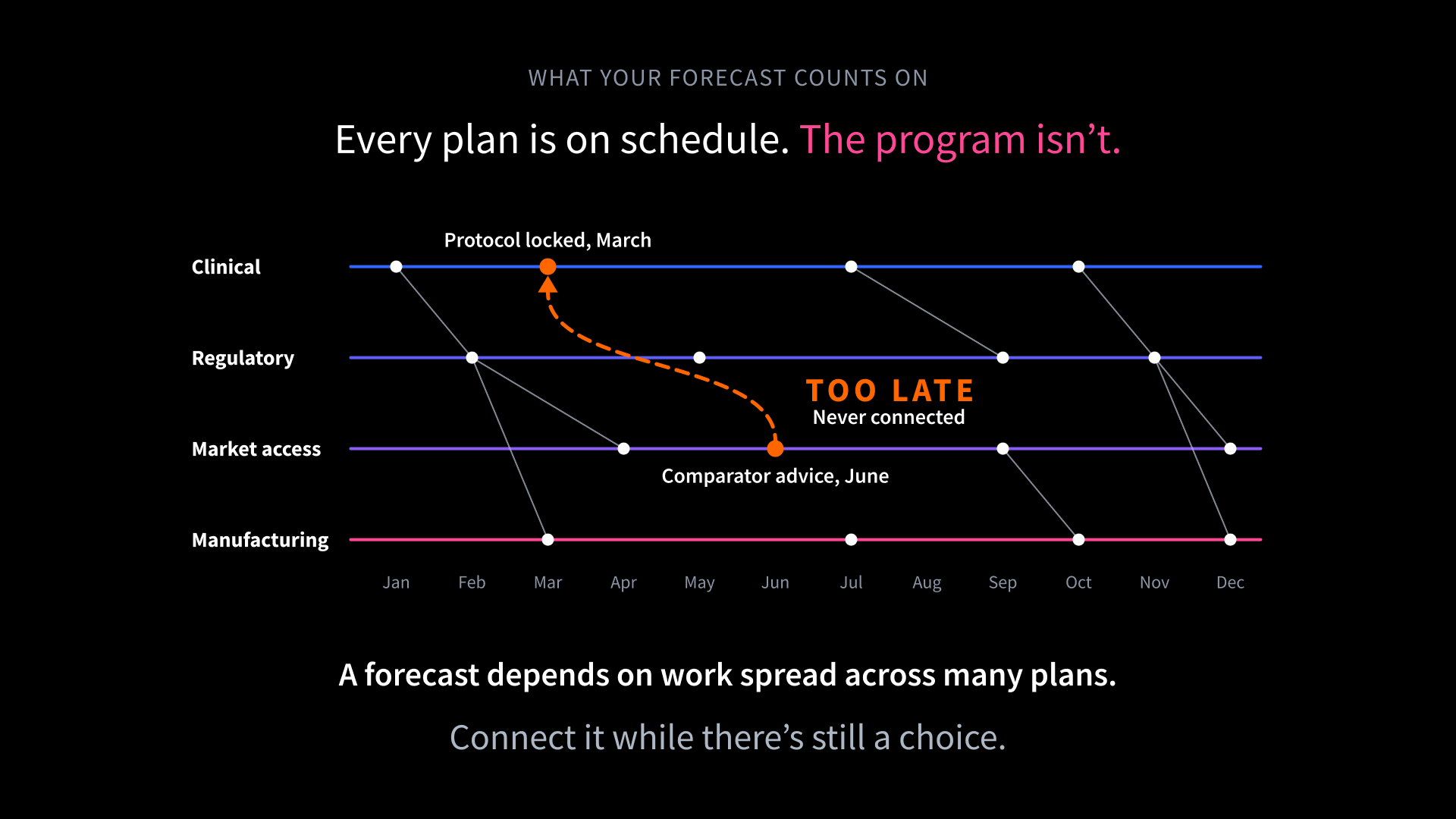
And it has to be the right place. A market access plan can have excellent owners and dates of its own. What matters is whether its work is tied to the decisions it affects in the development schedule. If the advice on the comparator is due in June and the protocol is locked in March, both plans can be on track while the program is quietly headed for the letter in the opening.
The same comparator decision, planned two ways
Take one decision and follow it through two versions of the same program.
It's January. The Phase 3 protocol is due to be finalized in March. The clinical team favors Treatment A as the comparator: it is widely used, the regulator has accepted it before, and sites can recruit against it quickly. Market access believes the German assessors will expect Treatment B, which has become the standard of care for this group of patients. A trial against Treatment B would be slower to enroll and more expensive to run.
In the first version of the program, the plan is built around milestones: protocol finalized, first patient enrolled, last patient enrolled, data locked for analysis, submission filed, launch. The comparator is a detail inside the protocol. Market access's concern is raised in a meeting, discussed and noted. In Germany, a company can ask the G-BA for advice on the appropriate comparator before Phase 3 begins, and market access intends to request it. But that request lives in market access's own plan, with a date that happens to fall after March. The protocol is locked on schedule with Treatment A. Nobody overruled anyone. The question simply ran out of time before it was answered.
In the second version, the comparator choice is a task in the integrated plan. It has an owner, it requires the German advice as an input, and it sits on the critical path, the chain of tasks that determines the earliest the program can finish, directly ahead of protocol finalization. In January, everyone can see that the protocol can't be locked in March on schedule unless the advice arrives first. The disagreement between clinical and market access is no longer a comment in meeting notes. It is a visible fork in the plan, with a date attached.
That doesn't make the answer obvious. The company still faces a real trade-off, and there are several sensible ways through it. It can accept a slower, more expensive trial against Treatment B to protect the price. It can keep Treatment A and add a separate study for the German assessment. It can keep Treatment A and lower the forecast for Germany now, rather than discover the cost three years later. It can narrow the patient population to one where the comparator question is easier. Each of these has a cost, and reasonable leaders could choose differently.
What changes is that the choice gets made knowingly, while every option is still open, by people who can see both the clinical cost and the commercial one.
Comparators are a real and recurring problem, not a hypothetical one. In one review of Germany's early benefit assessments under its AMNOG law, the comparator the assessors set differed from the one used in Phase 3 in 12 of the first 27 cases (Ruof and colleagues, 2014). A more recent review of 15 years of assessments found the share of medicines judged to show no added benefit rose from about 53% to 64%, with the choice of comparator among the factors the authors examined (Tomeczkowski and colleagues, 2026). The advice is not binding, and the right comparator can change between the advice and the assessment as treatment guidelines move. A better plan doesn't remove that uncertainty. It makes sure the company faces it in January, not after approval.
The same logic applies to timing. A competitor's expected launch date usually lives in a competitive intelligence briefing, outside the development plan. That matters because when a similar medicine reaches patients first, doctors and patients settle on it, and the second medicine has to win them over. Using data from 50 medicines that entered US markets after comparable competitors, researchers estimated that each additional quarter of delay reduced a second entrant's peak market share by about 0.9 percentage points (Regnier and Ridley, 2015). If the competitor's date sits in the plan as an outside dependency, every slip in the company's own schedule can be read against it. A plan can be on time against its own baseline and still miss the window the forecast was built on.
When the plan changes
Plans change constantly, and they should. An endpoint, the specific outcome a trial measures to judge whether a treatment works, is swapped for one that can be measured sooner. One arm of the study is dropped to save money. A country is replaced because its sites are slow to open. The data lock slips by a quarter.
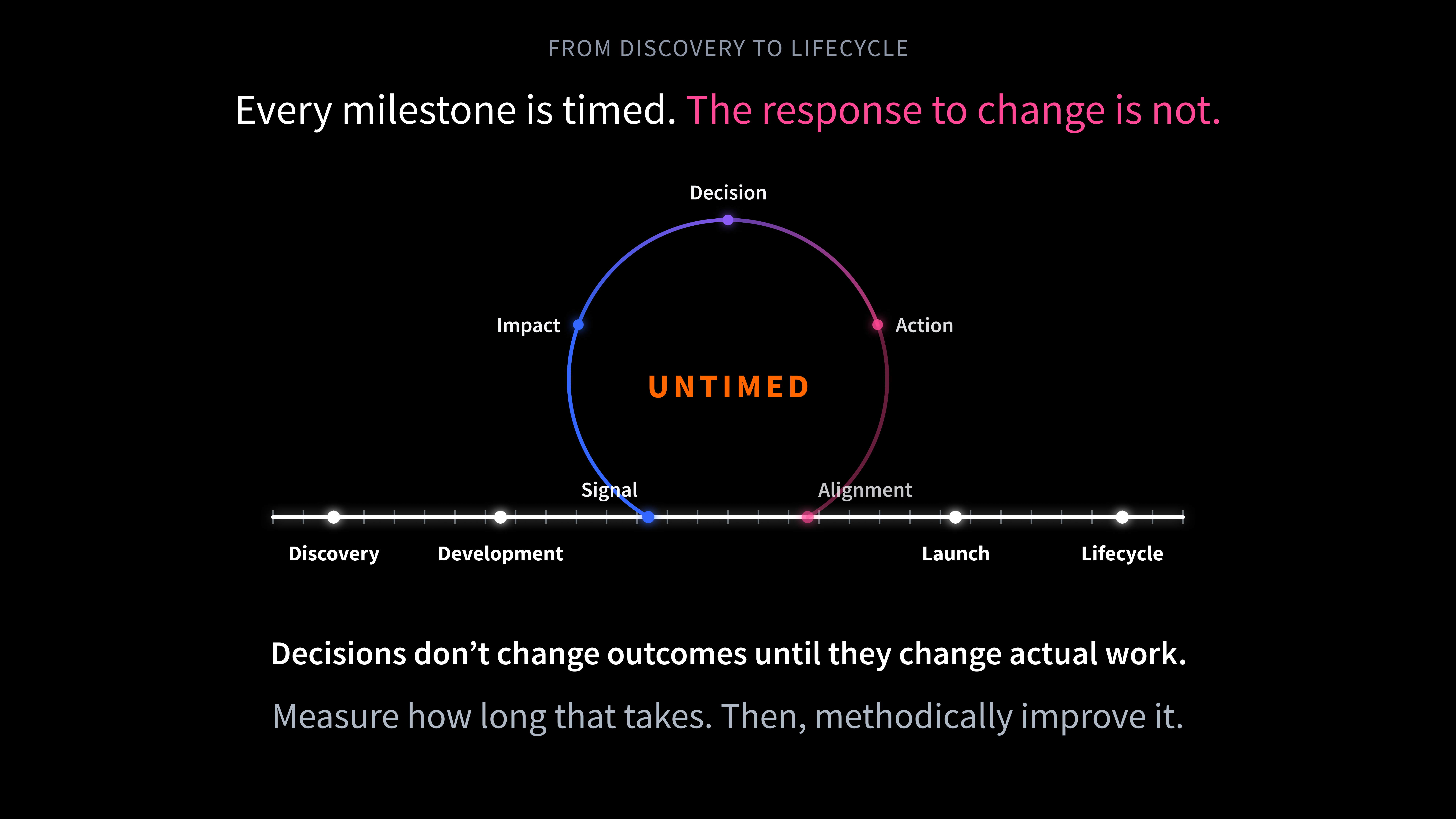
Each change gets reviewed, and the review naturally focuses on what a milestone plan can show: the effect on schedule, budget and scope. What it may not show is the effect on the conditions the forecast depends on. A new endpoint can be faster to measure and still be weaker evidence for the specific claim on the label that sets the medicine apart from its competitors, and that claim is what supports the price. A quarter's slip can be harmless on its own and still move the launch behind a competitor's. Those effects tend to surface later, at the next forecast update or stage gate, after the change has been approved and the work has moved on.
When each condition is tied to the work and decisions that bear on it, the same change arrives at approval with its effect on those conditions in view: the endpoint swap alongside the label claim it affects, the slip alongside the competitor's expected date.
The decision may well be the same. The difference is that it is made with both sets of facts on the table.
Three questions for your next program review
You can try this on your own portfolio in about an hour. It's a diagnostic, not a benchmark, and it works best done together with the people who own the forecast and the plan.
Start with your lead asset and ask the forecast owner for the five conditions that move its value most.
For each one, find the work around it. Don't expect it to be in one place. The comparator alone involves clinical, regulatory, market access and health economics, each with its own plan and often its own tool. List the tasks, their owners and their dates, then the decision in the integrated development plan they feed. Then check whether those pieces know about each other: whether the market access task knows the protocol date it has to beat, and whether the protocol date knows it is waiting on market access. Tasks that each look on track in their own plans, but aren't connected to each other or to the decision they affect, are the gap this article is about.
Then take the last three approved changes to that asset's plan and ask whether, at the time of approval, anyone could see which of those five conditions each change touched.
If every answer is clear, you've established that those connections exist for the conditions you examined. If some aren't, you'll know exactly where to look.
This is the problem we built Unipr to solve. A program's plans will always live with different functions, and often in different tools, for good reasons. We connect them across those boundaries without asking anyone to give up their own plan, link each piece of work to the decisions and conditions it bears on, and show what a proposed change is likely to affect before it's approved. That way a forecast is not only built forward from plan dates; it can be traced back to the work across functions that determines whether its conditions hold.
The choice was still open in January
A different planning process might not have changed the letter. The advice might have pointed to Treatment A after all, or the company might have weighed the trade-off and chosen speed knowingly. But by the time the letter arrived, the chance to generate the evidence the assessors wanted had long passed. The question that mattered could have been raised in January, three years earlier, while the company still had choices. The plan had no place for it.
Science takes the time it takes. Whether the work around it is connected to what the forecast is counting on is in our hands.
References
- Ting Wang, Neil McAuslane, Wim G. Goettsch, Hubert G. M. Leufkens and Marie L. De Bruin, "Challenges and Opportunities for Companies to Build HTA/Payer Perspectives Into Drug Development Through the Use of a Dynamic Target Product Profile," Frontiers in Pharmacology, 13:948161, 2022.
- Jörg Ruof, Friedrich Wilhelm Schwartz, J.-Matthias Graf von der Schulenburg and Charalabos-Markos Dintsios, "Early benefit assessment (EBA) in Germany: analysing decisions 18 months after introducing the new AMNOG legislation," European Journal of Health Economics, 15(6):577-589, 2014.
- Jörg Tomeczkowski and colleagues, "Fifteen Years of German HTA (AMNOG): Trends and Drivers of No Added Benefit," ISPOR Europe 2026, poster.
- Michael R. Myers, Michael Kinch, Kevin Murgas, Tyler Schwartz, Zachary Kraft and Andreas Dimakakos, "Blockbuster drugs and forecast accuracy: How sponsor type is associated with commercial success of FDA-approved medicines," Drug Discovery Today, 31(6):104832, 2026.
- Stéphane A. Regnier and David B. Ridley, "Market watch: Forecasting market share in the US pharmaceutical market," Nature Reviews Drug Discovery, 14(9):594-595, 2015.
Further reading
- How Much of Your Timeline Is Actually the Science?
- "Of Course..." How Assumptions Fail Programs at Predictable Inflection Points
- The Kill Decision Problem
- You Can't Run a Movie from a Single Frame

Security & Trust
We never train models on your data without your explicit request and consent.
Our controls, policies, and current audit status are published in our Trust Center.



Start Building Today
Log in or create a free account to scope, build, map, compare, and enrich your projects with Planner.