


The Four Cycle Times for Accelerating Medicines, Hiding in Plain Sight
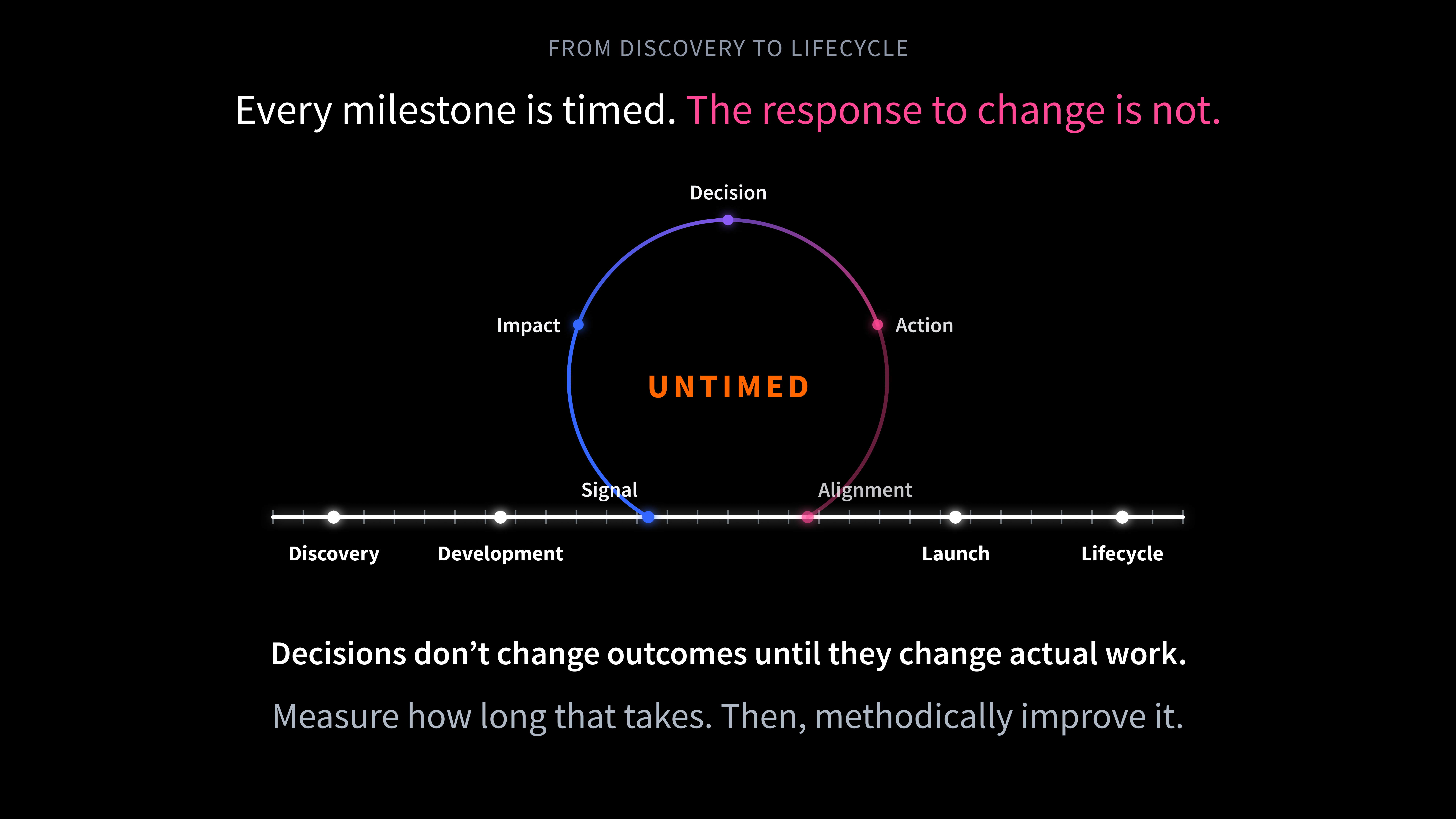
The time for ground reality to reach a decision, and for that decision to reach every function it changes, from discovery to lifecycle, is untimed, and so overlooked.

"There's a question back there," the moderator said. It was mine.
It was the morning of September 29, at the EP3M Summit in Boston, and the keynote panel had spent the better part of an hour on how the industry's best portfolio teams make decisions. Novartis had retired its annual portfolio review in favor of quarterly strategic reviews with monthly governance beneath them. Joe Charest, who heads portfolio strategy and analytics at Biogen, argued that a great review should be triggered by events rather than dates.
My question was about the other half of the journey. Whether a year passes between reviews, or six months, or three, something happens in the meantime. A competitor reads out. A regulator writes. A batch fails. I asked how long it takes "for that signal to become a decision and decision to come back down to the people or individual contributors who are actually doing something about it," and whether anyone on the stage measured those cycle times: signal to decision, decision to action, action to outcome.
Peter Ray of Novartis answered first, and sensibly. Separate asset decisions from portfolio decisions, he said. When an event touches a single project, "the response should be much faster," and governance is built to react. A shock large enough to move the whole pipeline triggers an ad hoc review rather than waiting for the cycle.
Joe Stalder, who leads program management at cAMPfield Therapeutics, offered the view from the other end of the industry. "Maybe that's a big pharma problem," he said, "because at my little company, especially now at 15 people, we can have that move through the organization in one day."
Then Charest gave the answer I have thought about most since. "We no longer have the excuse of we don't have enough data, it doesn't come to us fast enough, and we don't have the right tools." The lag, he said, is an internal decision about the threshold at which an accumulation of events becomes worth acting on. "We want to avoid recency bias."
All three answers were right, and all three were about reaching the decision. None described how long the decision took to come back down, and that is no failing of the panel. I have found no company that reports that number, and no industry benchmark for it.
The industry gets faster at whatever it times
On the dimensions it has chosen to measure, this industry has run one of the most disciplined improvement campaigns in modern management.
Eli Lilly is the clearest case. In 2017 its chief executive, Dave Ricks, said that if the company could "organize everyone at the beginning, we'd go from nine years to six" between first human dose and launch. By early 2024 Lilly was reporting 6.2 years. Pfizer showed during the pandemic what running development work in parallel rather than in sequence could do. Bayer rebuilt its operating model around three-month cycles in place of annual planning, with faster decisions as the stated aim. And on September 28, the day before that panel, Roche told investors it is on track to take about 19 months out of its R&D cycle times between the end of 2023 and the end of 2026.
Governance has quickened alongside. At the same summit, AbbVie's Ollie Osunkunle described the move from an annual portfolio review to quarterly prioritization, with the preparation for each review cut by more than half over six cycles. Roche now asks its target assessment teams for a recommendation within a couple of weeks.
A month taken out of a development timeline is a month a patient does not wait, and a month of revenue a company does not forgo.
Every cycle time the industry reports runs along the medicine
Each of those numbers comes with a definition, and the definitions show what the industry has learned to see. Roche's footnote reads "From Lead Identification to end of Phase 3." Lilly's slide measures portfolio entry to first human dose, and first human dose to first launch. Elsewhere it is phase duration, enrollment speed, the time from one milestone to the next. They time the artifacts the work produces, and they time them well, because milestones are visible, dated and owned.
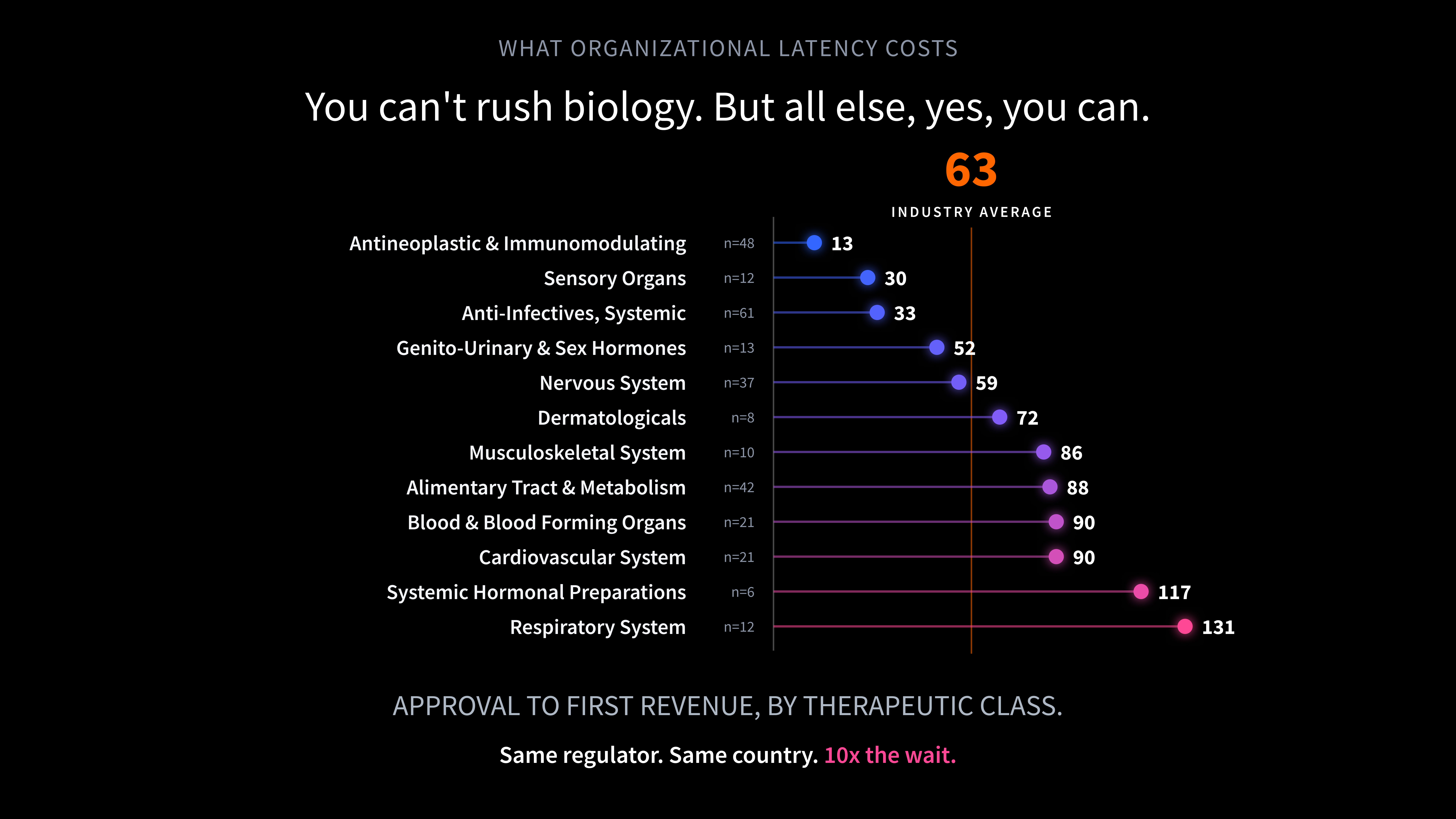
None of them starts when something changes. A competitor's readout does not start a clock. Neither does a regulator's question, a failed batch, a safety signal, or an assumption that quietly stops being true. Yet each of those events sets off work across the organization that can run for months: working out what it touches, deciding what to do, carrying the decision into every plan it changes, and making sure everyone who needs to know does. In September I argued that much of a development timeline is organizational time layered on top of the science. Response time is the part of it a leader can most directly control, and it sits inside every timeline the industry reports without ever appearing on one as a line.
The industry times the medicine. Almost nobody times the organization's response to what happens to it.
The aggregate numbers suggest what is at stake. Among the 25 largest listed biopharma companies, the median development timeline from Phase I to approval has stretched from 8.4 years to 9.3 over the last five years, according to Norstella's new productivity index, during the same years that Lilly and Roche were getting faster. IQVIA finds that the gaps between one trial ending and the next beginning add about 17 months to a typical development program. Not all of that is organizational; end-of-phase meetings and analysis live there too. But it is where the next decision is made and carried out, and IQVIA's latest report finds those gaps lengthening.
A decision is a round trip
Organization designers described the underlying mechanics half a century ago. When work is uncertain, the exceptions climb the hierarchy for a decision and the decision comes back down, and the more uncertain the work, the more the hierarchy clogs with traffic in both directions. Few industries live with more uncertainty than this one.
In a pharmaceutical company the trip up starts with ground reality: the tasks, deliverables and milestones where a change first shows itself. It climbs through programs to the portfolio, where it meets what the company knows and what the world is doing, and a decision is made. Then the trip back begins. The decision has to reach every program, function, workstream and person who must now do different things differently, and everyone who is not changing their own work but needs to know that others are. Along the way it crosses every tool, every process and every functional boundary the organization has, from research to lifecycle management.
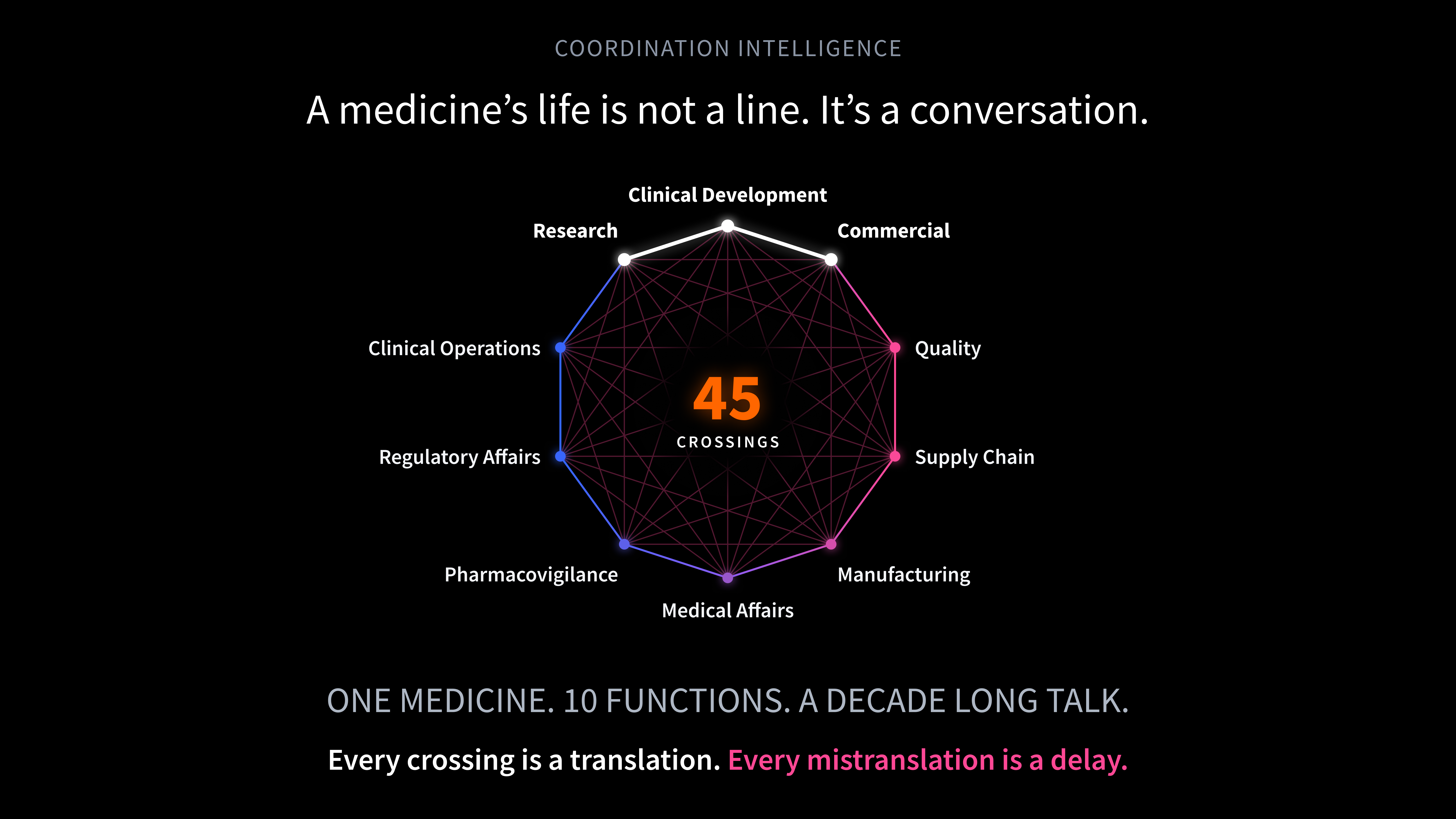
Stalder's one day is an instructive contrast. At 15 people every function sits in one room, so the round trip is a conversation. At scale the same trip crosses ten functions, dozens of partners, affiliates in many countries, and the systems each of them runs. Scope and regulatory weight differ too, but much of the gap between a day and a season lies in the number of boundaries a decision has to cross, and whether anything carries it across them.
Four dates for every change that matters
The round trip can be timed with five dates that most organizations already hold somewhere, and the four intervals between them.
The four intervals run end to end, so together they give the total time from a recorded change to the moment every affected plan has changed and everyone who needs to know has acknowledged it. A changed plan is a proxy for action, not proof of it; it is the earliest point at which a function has committed in writing to working differently. Measure each interval to the slowest affected function, not the average, because a change is not complete until it is complete everywhere.
Timing every signal would bury an organization in its own instrument, so do not try. Each program, function and initiative should decide which kinds of signal matter most to it, and start there. What matters to a CMC team is not what matters to supply chain or to a launch team, and a small-molecule franchise does not face the same surprises as a single-dose vaccine. Pick the few highest-priority signal types, know in advance which decisions each one demands, time those rigorously, and improve them until the response is dependable. Only then move to the next tier. Done that way, response time stops being an art practiced by a few experienced people and becomes a discipline the whole organization can improve, which is the only way it will shorten at scale.
One protocol amendment shows how long the trip back takes
Follow a single change all the way around.
An enrollment problem surfaces at the sites of a Phase 3 study: the eligibility criteria are excluding patients the investigators believe should qualify. That is the signal. Working out what it touches means establishing which studies share the criteria, which sites and vendors are affected, what it does to the drug supply forecast and the statistical plan, and what moves downstream in the submission and the launch sequence behind it. In most companies that picture is assembled by asking, one function at a time, and the asking takes days or weeks. I believe a first picture of what a change touches should take minutes. Confirming it will take longer, but the confirming should start from that picture rather than from a round of emails.
The decision needs the evidence gathered, internal and external, and tested against the options. If those options were worked out before the signal arrived, that interval is short. If they are worked out afterward, it is not, which is the argument I made in Despite Scenario Planning, Why Can't Your Teams Pivot Fast Enough.
Then the trip back. The protocol, the site contracts, the supply plan, the statistical analysis and the regulatory strategy each change in their own system, on their own calendar. And alignment reaches beyond the people whose work has changed: the medical science liaison fielding investigator questions, the forecaster whose enrollment curve just moved, the partner whose next milestone quietly depends on the outcome.
When researchers at the Tufts Center for the Study of Drug Development examined protocol amendments, they came as close as anyone has to measuring the trip back. Once a company has approved an amendment internally, a median of 190 days pass before the last oversight body approves it, and for months in between, sites work from different versions of the same protocol. Some of that is unavoidable: ethics committees and regulators set their own clocks, and sites cannot switch versions before their approvals arrive. But the weeks spent preparing each submission, the sequencing of those submissions, and how quickly each site moves once it is cleared are the sponsor's own. The companies judged most of their amendments unavoidable. The amendment may be. The half year after it is a separate question, and the sponsor's share of it is the part a sponsor can work on.
In August I wrote about what a decision loses in meaning as it crosses functions. The same crossings cost time as well.
A wait is deliberate only when someone decided it
Charest's point deserves its full weight, because it is the strongest objection to everything above. Some delay is wisdom. Evidence accumulates; a readout is due next month; the signal may be noise. An organization that lunges at every data point produces whiplash, and recency bias is real. I share his view of what a portfolio should do: adapt when the market, the data or the environment require it. Not before, and not because the calendar says so.
The industry already has a tool for the deliberate kind of waiting. Noel Sobelman, who moderated the panel, described boundary agreements: guardrails around a project which, once breached, trigger an interim or exception review.
So the instrument has to tell deliberate waiting from the other kind, without letting the label become a way to flatter the numbers. A wait is deliberate when someone decided it, wrote down what would end it, and told the people waiting. Recording that decision does not stop the clock. It labels the time. Report the total elapsed time, and beside it the share that was waiting someone chose or a regulator imposed. A leadership team can then see both how long the response took and how much of it was in its own hands.
Apply that test and an asymmetry appears. Chosen waiting lives mostly on the trip up, between knowing the impact and making the call. The trip back has waiting too, but most of it is imposed rather than chosen: an ethics committee's review, a regulator's clock. That can be labeled as well. What is left once both are labeled is the internal delay nobody intended. Nobody decides to leave a supply plan a month out of date on purpose. Each of those delays may have an owner inside its own function. Almost none has an owner from one end of the trip to the other.
Neither trip has a timestamp, so the calendar stands in
Ask a portfolio team when its last review was and you will get a date. Ask when the portfolio last needed to change and you will get a pause.
Periodic reviews do real work: they set strategy, allocate capital and give leadership a structured look at the whole. The trouble starts when the calendar is also the trigger for responding to change. If every change arrived with its consequences already traced, the portfolio would move on the size of the impact, and an exception review would convene when the impact crossed a threshold rather than when the quarter ended. Charest said as much from the stage: a great review is "triggered by accumulation of events and decisions," and then, candidly, "this is very hard to do." It is hard because nobody can tell, in the moment, when the accumulation has crossed the line. The calendar substitutes for a clock the organization does not have.
The best-run groups do time something. I recently spoke with a portfolio executive who once ran program management at a top 50 pharma company. In his group, every function's plan was current by the 20th of each month, with six days to resolve whatever had moved. It is a disciplined process, and still one organized around a calendar. Unless something triggers an exception, a change that lands on the 21st may not enter the next reconciliation for nearly a month.
The trip back is harder to see than the trip up. The first three intervals each end in something with a date on it: an impact assessment, a line in the minutes, a revised plan. The fourth ends when the last person who needs to know has acknowledged it, and in most organizations nothing records that day.
Researchers who go looking run into the same wall. The Tufts team could not collect the cost of implementing amendments, in part because companies had difficulty getting the data "from other functions in their organization." A separate team studying clinical trial contracting could not combine results across institutions because start and end points "are often defined differently across centers." My own reading is that the time between functions is hard to measure for much the same reason it accumulates: no single function owns it end to end.
And it runs the whole length of a medicine's life. In research, a target is deprioritized and a partner learns of it a quarter later. In manufacturing, a single process change can keep two inventories alive for years while it works its way through every market's approval. At launch, a date moves, and medical affairs, market access and supply each learn of it on their own calendar. The same four intervals apply to each, and the industry's milestone clocks see none of them.
The question I will ask again
These are the cycle times we build Unipr to shorten, and the ones we ask a team to time when it tests us against the way it works today. But the instrument does not depend on us. Start with one program and the signal type that matters most to it, and take the most recent change of that kind. The first three dates can usually be recovered from email, minutes and plan histories. If the fourth cannot be found anywhere, that is the finding.
The industry has already shown that it gets faster at whatever it chooses to measure. Every company in that room could tell you, to the month, how long its last Phase 2 study took. Next September I intend to stand at the same microphone and ask my question again. I would like one of them to answer it with a number: how long their last decision took to arrive.
References
- Program, EP3M Summit: Executive Project, Program & Portfolio Management Summit, Cambridge Healthtech Institute, Boston, September 29 to 30, 2026. Keynote panel, "From Framework to Reality: Operationalizing Innovation Portfolio Management," September 29, 2026, moderated by Noel Sobelman, with Peter Ray, Joe Charest and Joe Stalder. Remarks quoted from the session recording; panelists spoke in a personal capacity.
- Eli Lilly and Company, J.P. Morgan Healthcare Conference presentation, January 9, 2024.
- "Innovating at the speed of the 21st century in pharmaceuticals," interview with David Ricks, McKinsey & Company, October 31, 2017.
- Pfizer, "Pfizer transforms research and development approach to break industry standards with lightspeed," 2022 Annual Report.
- Bayer, "Dynamic Shared Ownership," July 15, 2026.
- Roche, Pharma Day 2026 presentation, London, September 28, 2026.
- Norstella, "Introducing the Pipeline-to-Patient Productivity Index (P3i)," July 28, 2026.
- IQVIA Institute, "Global Trends in R&D 2025: Signs of Higher Efficiency and Productivity," June 2025.
- IQVIA Institute, "IQVIA Institute's Global R&D Trends 2026 Report Finds Credible Signal on AI-Enabled Programs," May 2026.
- Jay R. Galbraith, "Organization Design: An Information Processing View," Interfaces, 4(3):28-36, 1974.
- Getz K, Smith Z, Botto E, Murphy E, Dauchy A, "New Benchmarks on Protocol Amendment Practices, Trends and their Impact on Clinical Trial Performance," Therapeutic Innovation & Regulatory Science, 58(3):539-548, 2024.
- Lawrence CE, Bruce VNM, Salberg LD, et al., "Quantitative assessment of the impact of standard agreement templates on multisite clinical trial start up time," Journal of Clinical and Translational Science, 7:e204, 2023.
- Rob Harris, Meike Vanhooren, Kara Follmann, et al., "An Evaluation of Postapproval CMC Change Timelines," Pharmaceutical Engineering, September/October 2023.
Further reading
- How Much of Your Timeline Is Actually the Science?
- Despite Scenario Planning, Why Can't Your Teams Pivot Fast Enough
- How Functional Language Barriers Delay Medicines
- The Question Your Portfolio Review Never Truly Answers

Security & Trust
Our SOC 2 Type II examination is underway with Prescient Assurance. We never train models on your data without your explicit consent. Our controls, policies, and current audit status are published in our Trust Center.


Start Building Today
Log in or create a free account to scope, build, map, compare, and enrich your projects with Planner.