


How Much of Your Timeline Is Actually the Science?
Long development timelines carry months added not by science but by how work, information, and decisions move through the organization. That time can be taken back.

The request comes down in March. Find six months.
The program lead books the room for a full afternoon and the team does what good teams do. Somebody proposes a smaller sample size and the statistician walks through what it costs in power. Somebody asks whether the follow-up period can be compressed, and the medical lead explains what the endpoint needs in order to mature. Somebody floats dropping the second dose arm. Somebody raises a surrogate endpoint and the regulatory lead explains, patiently, why the agency will not accept it.
By six o'clock the room has found maybe eight weeks. All of it comes out of the science, and all of it carries risk, and everyone knows the eight weeks will be argued over twice more before anything moves.
Nobody in that room proposed shortening the three weeks it takes an impact assessment to reach every function it affects, or the fortnight the program spent waiting for a governance slot. Nobody costed the monthly cycle on which five downstream teams discover that an upstream date has moved, or the ten days after the decision before the plans reflected it.
Those weeks are real. They are inside the timeline the team was just asked to shorten. They are simply not on it as a line item, and so they were never candidates for cutting.
I have sat in a version of that room on four continents, and the pattern does not change. When an organization goes looking for time, it looks in the science, because the science is the part that has names.
Two kinds of time sit inside every program timeline
One clock is set by nature. A six-month stability study takes six months. Cells grow at the rate cells grow. An immune response has to develop before you can measure it, toxicity has to emerge before you can observe it, and a survival endpoint arrives only after patients have lived it. You can design around this clock. You cannot argue with it. Call it scientific time, and accept that almost none of it is recoverable.
The other clock is set by the organization. Waiting on the function upstream before work can start. Discovering a dependency after it has already slipped. Reconciling two plans that disagree about the same date. Preparing governance materials instead of doing the work the governance is about. Carrying one decision to the twenty places it changes something. Rebuilding the same picture in a second format for a different audience. Working for weeks against an assumption that expired.
This clock is organizational time, and the avoidable part of it is what I want to name. Organizational latency is the avoidable elapsed time a program accumulates because of the way work, information, decisions and dependencies move through an organization: the waiting, the handoffs, the reconciliation, the governance calendar, the distance a decision travels before it reaches everything it changes. Not all organizational time is latency. A great deal of review and coordination earns its place. But unlike scientific time, this part can be reduced by changing how the organization operates.
None of this is carelessness. Every piece of it is somebody doing their job properly. The impact assessment takes three weeks because the person writing it has to ask four functions what the change touches, and those four functions each have to go and look. The monthly review exists because that is when the functions can all be in a room. The ten-day lag between decision and plan is one person re-entering a number in eleven systems. Each of those is defensible on its own. The sum is not.
The spread tells you more than the average
If you want to see where organizational time might be hiding, stop looking only at the average and look at the variance.
Take the window between regulatory approval and first revenue. The science is finished. The decision is made. Everything that happens in that window is execution.
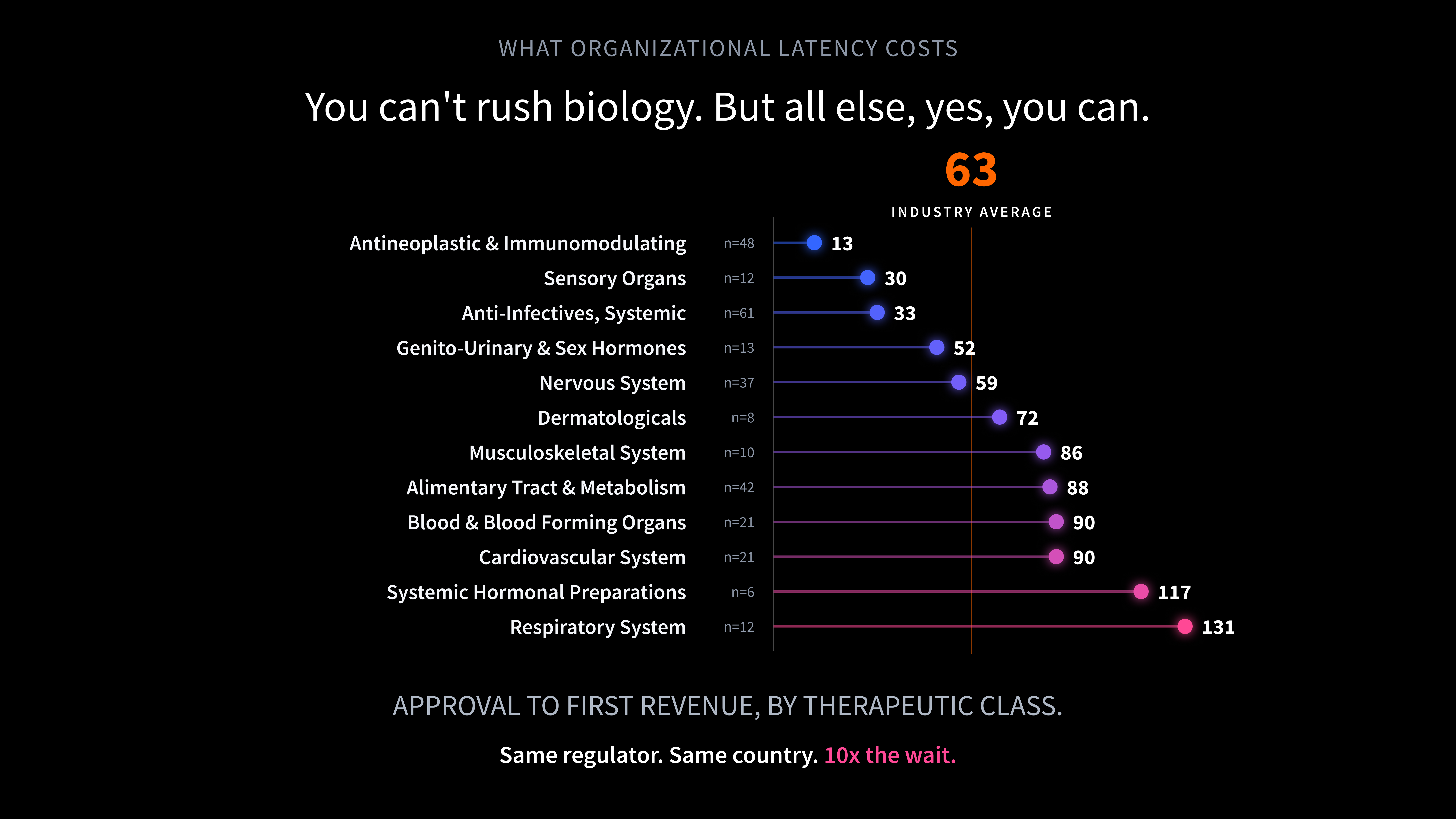
Our own analysis of 305 United States launches puts the average at 63 days. Antineoplastic and immunomodulating agents averaged 13 days across 48 launches. Respiratory products averaged 131 days across 12. Same regulator, same country, a tenfold difference in the elapsed time from approval to first revenue.
The spread does not mean all 63 days are organizational. Therapeutic classes differ in manufacturing complexity, cold chain, channel, risk management requirements and launch strategy, and some of that difference is real work under real constraints.
What it does show is that approval does not determine launch timing. A substantial execution window opens after the regulatory decision is made, its length varies by an order of magnitude between classes, and several products in that same cohort reached first revenue on the day of approval, with no delay at all.
What fills the gap is consistent and unglamorous: post-approval regulatory requirements, packaging and labeling readiness, batch release and inventory, distribution and channel readiness, payer and market access readiness, commercial systems and field readiness. These are execution and coordination problems, not drug development time. What sits in this window is an organization arranging itself around work it knew was coming: steps sequenced one after another that could have run alongside each other, a requirement discovered late, a function waiting because nobody told it that it was next. Many of those dependencies are visible well in advance. Some things are not: a regulator's unexpected request, a batch that fails. An organization that can see across its own functions registers the consequences of those at once, rather than at the next monthly review.
The cost of that window is not abstract either. For a major launch the revenue at risk runs past $10M, some of it merely delayed and some of it lost outright to a shorter effective exclusivity window. The money is the smaller cost. Every unnecessary day in that window is another day before an approved medicine starts reaching the patients who need it.
An agenda full of people describing the same thing
On Tuesday the EP3M Summit brings portfolio and program leaders from Merck, Biogen, Novartis, GSK, AbbVie, Eli Lilly, Sanofi, Bristol Myers Squibb, EMD Serono, UCB and a dozen other organizations into one room to talk about project, program and portfolio management in biopharma.
I read the program the way you read a diagnostic panel.
The opening keynote, from Noel Sobelman, asks why some organizations consistently translate strategy into measurable outcomes while others struggle with misaligned priorities, constrained resources and stalled pipelines.
Michael Ferrante of Merck co-presents a session titled The Portfolio Dilemma: Why Smart Systems Fail to Drive Smart Decisions, and the description is blunt about the cause: "The root cause isn't a lack of data, it's the behavioral and decision dynamics that undermine how that data is interpreted, governed, and acted upon. Misaligned incentives, delayed insights, and fragmented governance structures create a persistent disconnect between strategy and real-time project realities."
Joseph Robertson of UCB has a session on dashboards, and makes the observation that most dashboards are built as though completeness were achievable, so leaders end up filling the gaps with judgment, "often outside dashboards in Excel or PowerPoint."
Olaoluwakitan Osunkunle of AbbVie presents the journey to a quarterly portfolio prioritization process, and describes it as a transformation. Moving formal prioritization onto a quarterly rhythm is a real improvement on what most organizations manage. It also surfaces the tension underneath it: evidence arrives continuously, and governance arrives on a calendar.
Stephen Cho of BeOne Medicines moderates a panel on portfolio ownership, with Michael Ferrante, Patrick Higgins of Biogen, Shiv Shankar of BeOne and Siera Talbott of Cabaletta Bio. The framing is the tug of war between R&D ambition and financial discipline, and the description names what that costs: competing priorities, misaligned incentives and fragmented governance that "can slow decisions, dilute strategy, and limit value realization."
Kundini Amin and Elena Spencer of Biogen run a session on the human side of governance, which asks whether stakeholders feel safe to speak up in the room, and whether decisions made collaboratively are accurately reflected in what actually happens afterward.
Tilo Senger of EMD Serono speaks on building a global program management function, and frames the task as connecting local execution, cross-regional coordination and enterprise-level decision making without losing strategic coherence.
Shawn Malloy of Biogen co-runs a working session on why implementation fails, and on the early warning signs that a program is at risk before anyone has called it.
Eight sessions, and they are not describing eight problems. Each one names a mechanism by which organizational time accumulates, and they do not line up tidily: delayed insight in one, fragmented governance in another, judgment that ends up in Excel because the system cannot hold it, evidence arriving continuously into a process that meets four times a year. What the program lacks is a shared name for the thing all of them are circling. Filed under governance, dashboards, prioritization, culture and regional operating models, they read as separate agenda items.
A quantity with no name does not get managed. It never reaches a timeline, so no team is ever asked to cut it.
The gap between functions belongs to nobody
Organizational latency has gone unnamed for a reason that is easy to state and hard to fix: it does not belong to anyone.
Every function's own time is accounted for, budgeted, defended and reported. Clinical knows what clinical costs. Regulatory knows its review cycles. Manufacturing knows its lead times. Each of them can tell you, to the week, how long their part takes and why.
The time between them belongs to no function and appears in no function's budget. The three weeks an impact assessment spends in transit sit on neither the clinical timeline nor the regulatory one. They fall in the gap, and nobody owns the gap or measures it.
An incentive layer sits on top of that. Raising a coordination problem costs the person who raises it. The work of fixing it lands on them, the benefit accrues to everyone else, and the failure mode they prevented is invisible by definition. The rational move for any individual is to manage their own function's time well and treat the gap as weather. Most people are doing exactly that, and they are not wrong to.
We have written before about how the same event carries different names in different functional systems, and about why the assumptions underneath a plan fail at predictable moments. Both are specific mechanisms through which organizational latency accumulates.
The AI being deployed now targets scientific output
I do not think better technology closes this gap on its own, and the current evidence is why.
In January, Drug Discovery Today published the DISRUPT-DS roundtable, in which senior data science leaders from 14 participating pharmaceutical companies, supported by structured interviews and a survey, benchmarked where generative AI had actually reached routine use or demonstrated value in their R&D organizations. It is a careful, unhyped piece of work and it is the best current picture of where the industry stands.
Go down their benchmark. Scientific chatbots, the most mature of all. Internal and external knowledge search. Document generation for research, and for clinical and regulatory work. Molecule design. Code writing. The study of diseases, targets and biomarkers. Data monitoring and harmonization. Biostatistical programming, still early.
Every one of those targets scientific output, documents, code or data. None of them targets how the work moves between the functions doing it. As far as I can establish, cross-functional coordination does not appear among the benchmarked use cases at all.
The summit agenda carries a live instance of the same pattern. Troy Langford of Novartis presents the design and implementation of an AI agent for portfolio analytics: a real system, built, running, and pointed at analyzing the portfolio.
An earlier benchmark from the same roundtable sharpens the picture. Asked where generative AI held strong potential, the companies put code generation at the top. Automated workflows came last, named by 25 percent. Automated workflows are not the same thing as cross-functional coordination. But the direction is hard to miss. Attention concentrated on what the technology could produce, and thinned out sharply on how the work itself moves.
The obstacles the participants named point the same way. Their leading challenges are data quality and availability, and embedding the technology into existing processes. The models are already good. What is scarce is the organization's ability to put them to work.
Which is why organizational latency is the thing to attack. When everyone can buy the same models at the same price, the difference between two companies is how well each one sees and coordinates itself. Content generation gets cheaper every quarter. There is no equivalent market for coordination.
Four intervals you can measure this afternoon
One particularly consequential form of organizational latency also happens to be one of the easiest to measure: the time an organization takes to respond once reality has changed.
You do not choose when a program changes. A readout disappoints, a supplier fails a quality check, a competitor reads out first, a regulator asks a new question. You choose only how long your organization takes to act on it. Between the moment something changes and the moment everyone affected is working against the change, there are four intervals, and each one is consumed by something specific.
How long from the signal to a written assessment of what it touches. How long from that assessment to a decision on record. How long from the decision to a re-sequenced plan. How long from that plan to every affected owner working against it.
In most organizations all four intervals can be reconstructed from artifacts that already exist. Pick the last significant change that hit one of your programs, put those four dates on a page, and by the end of the afternoon you will have one concrete measure of organizational latency in your own company. The leaders I have asked usually guess low.
That is the test I would carry into any room where portfolio management is being discussed at the summit. When someone describes a governance improvement, a new dashboard, a prioritization framework or an AI pilot, ask the same question each time: by how many days does this shorten the distance between something changing and everyone affected working against the change?
If the answer is none, the initiative may still be well worth doing. It is not shortening the response cycle.
I will publish the four intervals in full on October 5, with what consumes each one and how to measure it. Removing that time is the work we do at Unipr.
The science will take what the science takes. The organizational time layered around it is a different matter. Much of it is designed into the way information, decisions and dependencies move through a company, and it accumulates without anyone ever seeing the total.
References
- Program, EP3M Summit: Executive Project, Program & Portfolio Management Summit, Cambridge Healthtech Institute, September 29 to 30, 2026.
- The DISRUPT-DS Industry Roundtable, "Generative AI in pharmaceutical R&D: From large language models to AI agents to regulation," Drug Discovery Today, Volume 31, Number 1, January 2026, article 104593.
- Khan N.S. et al., "Data science in pharmaceutical R&D: the DISRUPT-DS industry roundtable," Nature Reviews Drug Discovery, 2024;23:645-646.
- Unipr analysis of 305 United States product launches. Mean elapsed days from FDA approval to first revenue, measured across 16 therapeutic classes, using FDA approval history and Unipr's own product first-day-in-market data. One extreme outlier product was excluded. Revenue impact from Evaluate Pharma, Top Selling Drugs 2021.
- Methodological source for the approval-to-first-revenue measure, a separate dataset: Mark R. Trusheim, Murray L. Aitken and Ernst R. Berndt, "Characterizing Markets for Biopharmaceutical Innovations: Do Biologics Differ from Small Molecules?" Frontiers in Health Policy Research, Volume 13, Article 1 (2010), Berkeley Electronic Press.
Further reading
- How Functional Language Barriers Delay Medicines
- Organizational Intelligence: The Enduring Advantage When AI Is Everywhere
- Of Course: How Assumptions Fail Programs at Predictable Inflection Points
- The Question Your Portfolio Review Never Truly Answers


Compliance
Unipr is built on trust, privacy, and enterprise-grade compliance. We never train our models on your data without your explicit request.






Start Building Today
Log in or create a free account to scope, build, map, compare, and enrich your projects with Planner.