


How Functional Language Barriers Delay Medicines
Ten functions working on the same medicine, with little shared vocabulary among them: what that costs and means.

Company town hall, a month after regulators accepted the submission. Somebody asks when the medicine launches.
The development lead says mid-March. That is the day the agency is expected to act.
Supply chain says early April. That is the first day product can physically ship.
Commercial says late May. That is when a patient can walk out of a pharmacy holding it.
All three are right. Each is reading their own system, and each system is correct. Nobody in the room is confused, nobody is being difficult, and nobody notices that one question has just produced three answers, because each person heard a different question inside the same word.
It is not only the date. In research, the medicine is a code: two letters and five digits. In the clinic, it acquires a generic name that a committee spent two years approving. Commercial gives it a brand name and spends a great deal of money to make people remember it. Supply chain knows it by a material number that appears in none of the others.
One molecule. Four names. Four systems holding them, and one patient who does not care about any of them.
Every one of those names is in your data warehouse tonight, alongside every one of those dates. A good master data program will have taught it that the four names belong to one molecule. Almost nothing will have taught it which of the three dates the patient actually experiences, or what each function is entitled to assume when it hears the word "launch".
The same word means four things, and four words mean the same thing
The trick runs in both directions, which is what makes it so hard to see.
Ask four functions whether something has been validated, and you will get four correct answers about four unrelated activities. Clinical means the data system. Quality means the method. Manufacturing means the process. Regulatory means the submission. Ask whether the product has been released, and nobody knows whether you mean a batch or a set of results.
A company that cannot tell meanings apart does not only miss the connections that are real. It confidently makes connections that are not.
Integration moved the data and left the meaning behind
The industry has been connecting its systems to each other for as long as it has had more than one of them. Every generation of tooling made that faster and broader, and the current one made the pattern standard: pull everything out of the source systems, land it in one data lake or data warehouse, then run the analytics on top. It worked. Data moves. A number entered in one place appears in another. The pipes today are excellent.
What the pipes never carry is meaning. Putting every function's data in one place means the rows now sit beside each other. It does not mean anybody has decided what they mean to each other. All three launch dates are in there, each correctly labeled, each one right. Nothing in the warehouse knows they are answers to the same question.
We wrote in March 2025 that coordination was the layer missing above all that connectivity. What we did not spotlight then: the thing that has to travel through that layer is not more data; it is agreement about what the data denotes. The job nobody was ever given is the one Star Wars gave to C-3PO: a protocol droid, fluent in six million forms of communication, whose whole purpose was to stand between parties who could not understand each other.
Put this challenge to a capable technology leader, and the answer comes straight back. "Every function's data is already on one platform. We can query across all of it. And whatever is still missing, AI will work out for us."
They hear "integration" when we say "coordination," and think "consolidation" when we say "meaning."
The record so far says otherwise. The world spent around $1.5 trillion on artificial intelligence last year, and roughly 6 in 10 AI projects are expected to be abandoned for want of data a machine can actually make sense of. Gartner puts it plainly: a schema tells a model how information is structured, not what any of it means. Show a model 3 columns called launch date, and it has no authoritative way to know which one governs the supply plan and which one a patient is waiting on. It will produce an answer. Nothing in the data tells it whether the answer is the right one.
Somebody has named this precisely, and put $4.5 billion behind it
Sarah O'Keeffe runs product research and development at Eli Lilly. Asked what the Lilly Medicine Foundry, a $4.5 billion site opening in Lebanon, Indiana, is for, she said this:
"The life cycle of a drug is very sequential: discovery scientists hand it to the development team, the development team hands it to manufacturing. There are sequences and handoffs, and understandably there are delays in that. That's what we're trying to solve."
Her remedy is to remove the paper and the meetings between those groups and put everything a click away, in one building. "The amount of time you can unlock between all those handoffs is significant."
She is right, and the size of the check may be the strongest price signal anyone has offered. When a company commits $4.5 billion to a design whose stated purpose includes collapsing the distance between research and manufacturing, it has told us something about what it believes closing that distance is worth. No model any of us could build would carry the same weight.
A medicine's life is not a line
Discovery to development to manufacturing is one chain, and it runs through the middle of a company where somebody can put a roof over it.
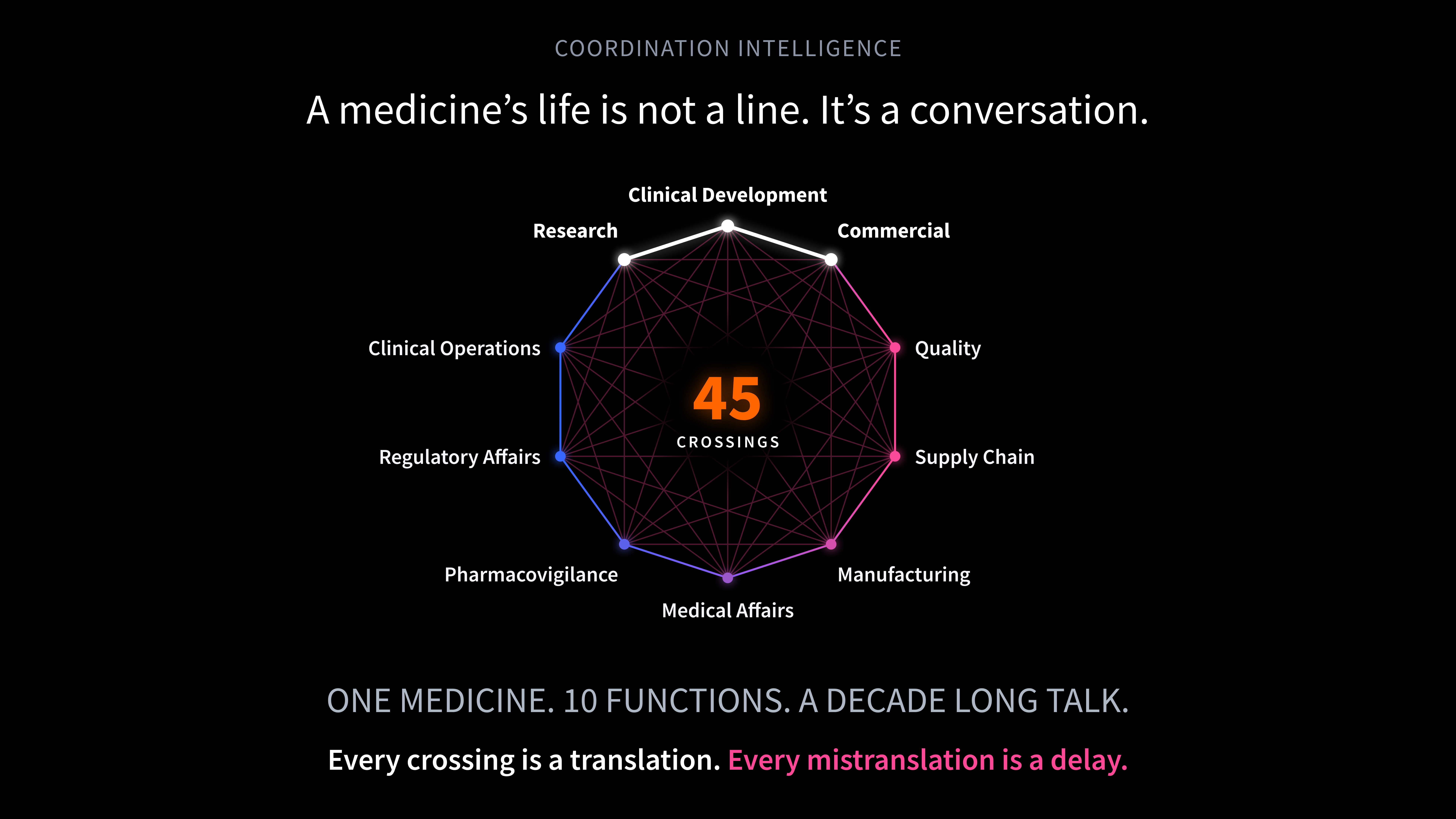
Now count the rest. Research, clinical development, clinical operations, regulatory affairs, medical affairs, commercial, supply chain, manufacturing, quality, pharmacovigilance. Ten functions can be paired 45 ways. A medicine's life does not exercise every pairing, but it exercises a great many of them, in both directions, repeatedly, for a decade or more. Safety tells clinical operations. Regulatory tells commercial. Quality tells supply chain. Clinical tells everyone.
And most of those crossings do not happen inside anyone's building. They happen at contract research organizations, at contract manufacturers, at investigator sites and laboratories, at distributors, and at the oversight bodies whose approvals nobody employs. You cannot put a roof over a network you do not own.
A handful of handoffs is a problem you can solve with architecture. Hundreds of them, most outside your walls, is a problem you have to solve with language.
Every handoff is a translation
Here is what one of those crossings actually looks like.
A single molecule has several plans running against it at the same time. Clinical development has one. CMC has another. Regulatory has a third for the submission. Each is well built, and each lives in its own system, maintained by people who know exactly what they are doing.
Follow the point where the trial data becomes usable downstream. Every one of those plans has a name for it. Clinical has database lock. CMC has data package ready. Regulatory works to a data cut-off date. Commercial has market data ready. Safety keeps its own safety database lock.
Five plans. Five names. They are not the same milestone, and that is the harder problem.
Each is a real date in a real plan. Nothing in any of those names reveals which of the others it waits on, or which ones move when it does. So no line is ever drawn between them, and nothing in any system records which of the others may need to move when one does. The relationship exists in the heads of a few specialists who have run this before, and it surfaces only when those people happen to be in the same meeting.
Which is why, when database lock slips by two weeks, the analysis and the study report slip with it and the submission date moves. That much is arithmetic. What is not automatic is anybody outside clinical finding out. The plans that key off that submission sit in other systems under other names, so the two weeks surface at the monthly review, by which point several functions have spent them planning against a date that no longer exists. Nobody was careless, and no plan was wrong. The handoff failed because nothing in either vocabulary revealed that the dates were connected.
And that is the flattering version, because it assumes each of those plans has its own internal dependencies drawn correctly. Many do not. Plans record sequence far more reliably than dependency: what comes after what, rather than what is genuinely waiting on what. A team that cannot always say which of its own tasks are truly blocking is unlikely to have written down what it owes another function, in another system, under another name.
The blindness starts inside a single plan and compounds outward. Across functions. Then across programs. Then across a portfolio, where nobody owns the question at all.
Multiply that by 45 pairings and a decade, and the delays O'Keeffe describes stop looking like isolated handoffs and start looking like a property of the system.
Any operator can test the pattern against their last program from memory.
Nobody is hoarding. They cannot translate.
Everyone's theory of silos is that people protect their patch.
When Gabriel Szulanski went looking for why good practice fails to travel between parts of the same company, he expected to find exactly that. He found something duller and considerably more fixable. The people sending were willing. The people receiving were willing. Unwillingness barely registered at all.
What stopped the transfer was that the receiving side could not absorb what arrived, the knowledge could not be cleanly stated in the first place, and the channel between the two was hard work. Not malice. Not politics. Friction of a specific and boring kind, which is very good news, because friction can be engineered out and human nature cannot.
The handoff sends the answer and loses the working
Here is the shape that friction takes at a handoff. The upstream function delivers what the downstream one needs: the package, the specification, the date. What does not travel is how any of it came about. The plan that produced it, the constraints that shaped it, the options that were weighed and closed. The receiving team gets the answer without the working.
So, it does the rational thing. It questions. A decision that looks arbitrary from the outside gets re-opened, argued, and frequently re-made the same way it was made the first time, a month later. Nobody is being obstructive. They were handed a conclusion and no way to audit it.
Here is the part that should give any executive pause. The dialects are not a defect. A function becomes precise by developing its own language. Quality means something exact by validation because being exact about validation is its job, and it would be worse at that job if it spoke loosely. Every vocabulary that makes a team sharp on the inside makes it opaque at its edges. These walls are built out of expertise, which is why hiring more experts raises them.
One center ran the same conversion three times
Handoff losses are hard to price, because nobody records the line they never drew. But one academic center published an account of doing the same work three times, and it is worth sitting with.
The Healey Center at Massachusetts General Hospital ran an ALS trial in 2017 on forms built to its own internal standards, then converted the data into the format regulators expect once the trial had closed. That conversion took an estimated 1,120 hours.
For the next trial they designed the forms to the standard first, so that the fields would map. The conversion took 320.
By the third trial they had stopped converting at the end at all and were doing it continuously, as the data arrived, having concluded that it was better to plan for standardization as early as possible than to treat it as something to be sorted out at closeout.
That is the argument in one team's experience. Deciding what things mean while the work happens costs something. Reconstructing it afterward, from columns somebody else filled in, costs more.
The last handoff costs 63 days, and the best launches do it in 14
O'Keeffe measures time in days for a patient, which is the right unit, so take the final handoff in a medicine's life and count it in days.
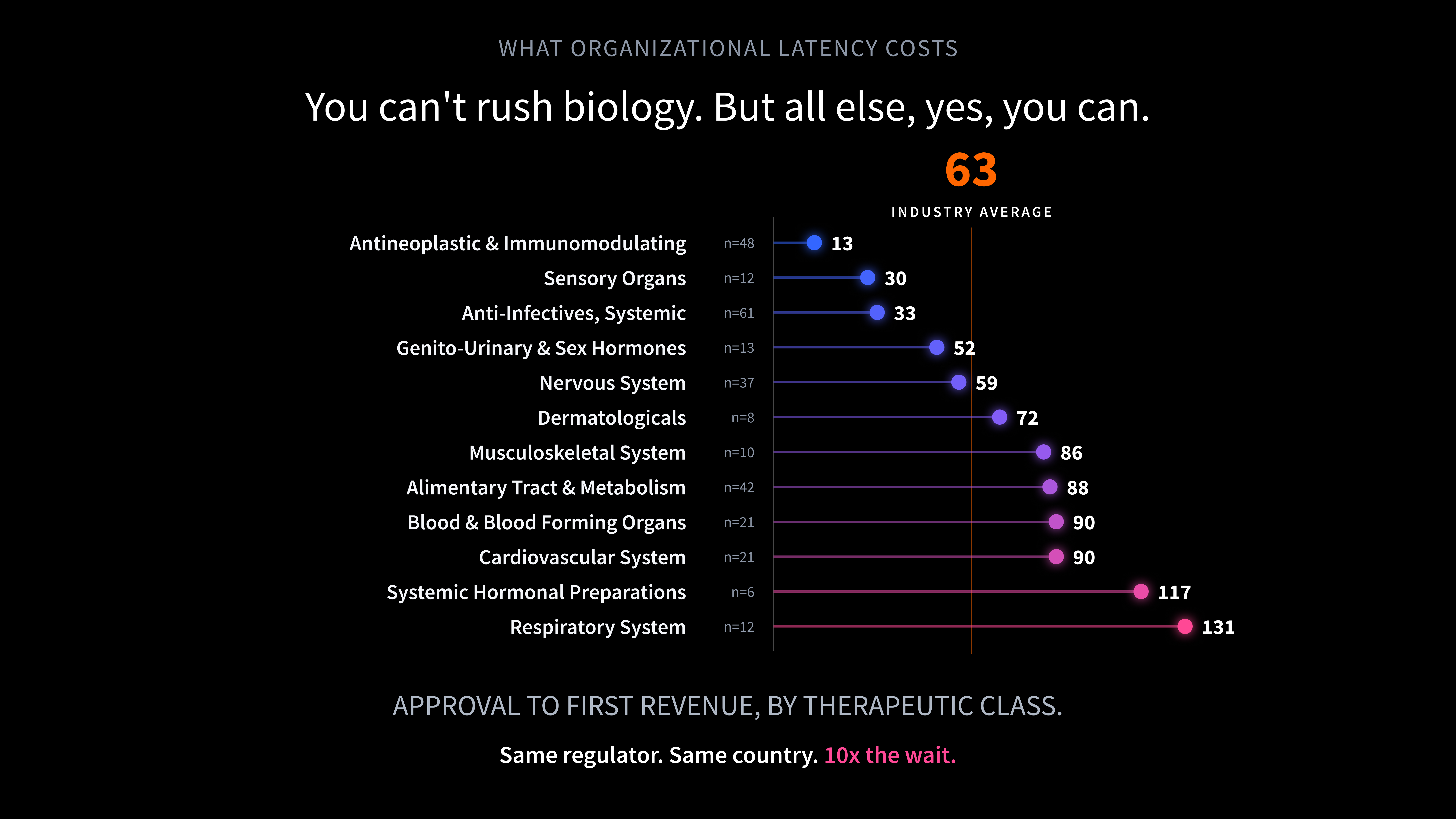
Approval to first sale. Regulatory hands to quality, quality to supply chain, supply chain to distribution, distribution to the pharmacy. Our own analysis of 305 United States launches puts the average gap at 63 days. Look underneath that average and it splits apart: 13 days in one therapeutic class, 162 in another. Same regulator. Same rules. Same country.
Some of that spread is genuine difference in what different medicines need once approved: cold chain, specialty distribution, a harder payer conversation. Every one of those, though, sits downstream of the approval, inside the machinery a company and its partners run to turn a license into something a patient can collect. None of it belongs to the regulator. And the best-run launches in the industry clear that same machinery in 14 days.
At roughly $800,000 in forgone sales for each day of delay, the difference is worth having. That is the number that moves a board. It is not the one that should. Two months, on a medicine already approved as safe and effective, while somebody waits for it.
The industry cannot price its own handoffs, and the reason is the answer
A gap like 63 days can be counted from outside, because approval dates and first sales are both public. What it cost inside the building, and which handoff spent it, is a different question. You would expect an industry this quantified to have an answer. It does not, and how it failed to find one is the most persuasive evidence here.
Two research teams set out recently to measure exactly this. Both were defeated by it, and both said so in print.
The Tufts Center for the Study of Drug Development tried to establish what a single protocol change costs a company. Sixteen pharmaceutical companies and contract research organizations took part, among them Amgen, AstraZeneca, Bristol Myers Squibb, Gilead, Johnson & Johnson, Lilly, Merck, Pfizer, Regeneron, Roche and Sanofi. Almost none could produce the figure, and part of the reason they gave was that the participating companies could not get the data out of neighboring functions in their own organizations.
A group led from Vanderbilt, with Mayo Clinic and the University of Utah, tried to measure how long site contracting takes. They could not combine what they collected, because the institutions did not agree on when contracting starts or when it ends.
A study about the cost of not sharing meaning could not be completed because the people involved did not share meaning. This has never been priced because pricing it requires the very thing whose absence is the problem.
The second faculty
This series began with organizational intelligence: a company's capacity to make itself visible to itself and move as one. It then named the first of the three faculties that capacity rests on, Contribution Intelligence, the ability to perceive what each person can actually contribute and the conditions under which they will.
This is the second. Coordination Intelligence: the capacity for meaning to travel intact across every boundary the work crosses, so that a decision made in one place becomes true in all of them, at the speed the decision deserves.
Perceiving people is what lets an organization see. Coordinating them is what lets it move. The third faculty, the one that lets it remember, comes next.
Go and count the names
Take one medicine. List every moment in its life where the work passes from one function to another: the readouts, the locks, the releases, the approvals, the transfers, the launches.
For each one, count how many different names it carries across your systems. Then count how many genuinely different things share a single name.
Then pick the three that moved last quarter and ask, for each, which other plans moved with it and whether anybody had written down that they would. Then ask the team downstream whether they could see why the decision was made, or only what it was.
It takes an afternoon. It needs nobody's permission and no budget, and it will tell you more about why your programs run late than a quarter of steering committees. As far as I can establish, no pharmaceutical company has ever published that number.
O'Keeffe is right that the time between the handoffs is where the days are. The building can collapse two of those handoffs. The rest are waiting in the words.
References
- Christel M. "Accelerating Speed to Patient: A Conversation with Eli Lilly's Sarah O'Keeffe." Pharmaceutical Executive, June 2026.
- Eli Lilly and Company. "Lilly announces new $4.5 billion site, Lilly Medicine Foundry," October 2024.
- Jentoft K, Tustison E, Yu H. "CDISC Implementation in an Academic Research Organization." Journal of the Society for Clinical Data Management, February 2023.
- Szulanski G. "Exploring internal stickiness: Impediments to the transfer of best practice within the firm." Strategic Management Journal 17, Winter Special Issue, 27-43, 1996.
- Getz K, Smith Z, Botto E, Murphy E, Dauchy A. "New Benchmarks on Protocol Amendment Practices, Trends and their Impact on Clinical Trial Performance." Therapeutic Innovation & Regulatory Science, March 2024.
- Lawrence CE, Bruce V(N)M, Salberg LD, et al. "Quantitative assessment of the impact of standard agreement templates on multisite clinical trial start up time." Journal of Clinical and Translational Science 7:e204, 2023.
- Smith Z, DiMasi J, Getz K. "New Estimates on the Cost of a Delay Day in Drug Development." Therapeutic Innovation & Regulatory Science, 2024.
- Gartner. "Lack of AI-Ready Data Puts AI Projects at Risk," February 2025.
- Gartner. "Worldwide AI Spending Will Total $1.5 Trillion in 2025," September 2025.
- Gartner. "Lack of Semantics Causes Inaccurate Artificial Intelligence Agents and Wasted Spending," May 2026.
- Unipr analysis of 305 United States product launches, based on FDA approval history and product first-day-in-market data. Methodology anchored to MIT Forum for Health Economics & Policy (Frontiers in Health Policy Research), 2010, 13.1, pp 1-45, The Berkeley Electronic Press.


Compliance
Unipr is built on trust, privacy, and enterprise-grade compliance. We never train our models on your data without your explicit request.







Start Building Today
Log in or create a free account to scope, build, map, compare, and enrich your projects with Planner.